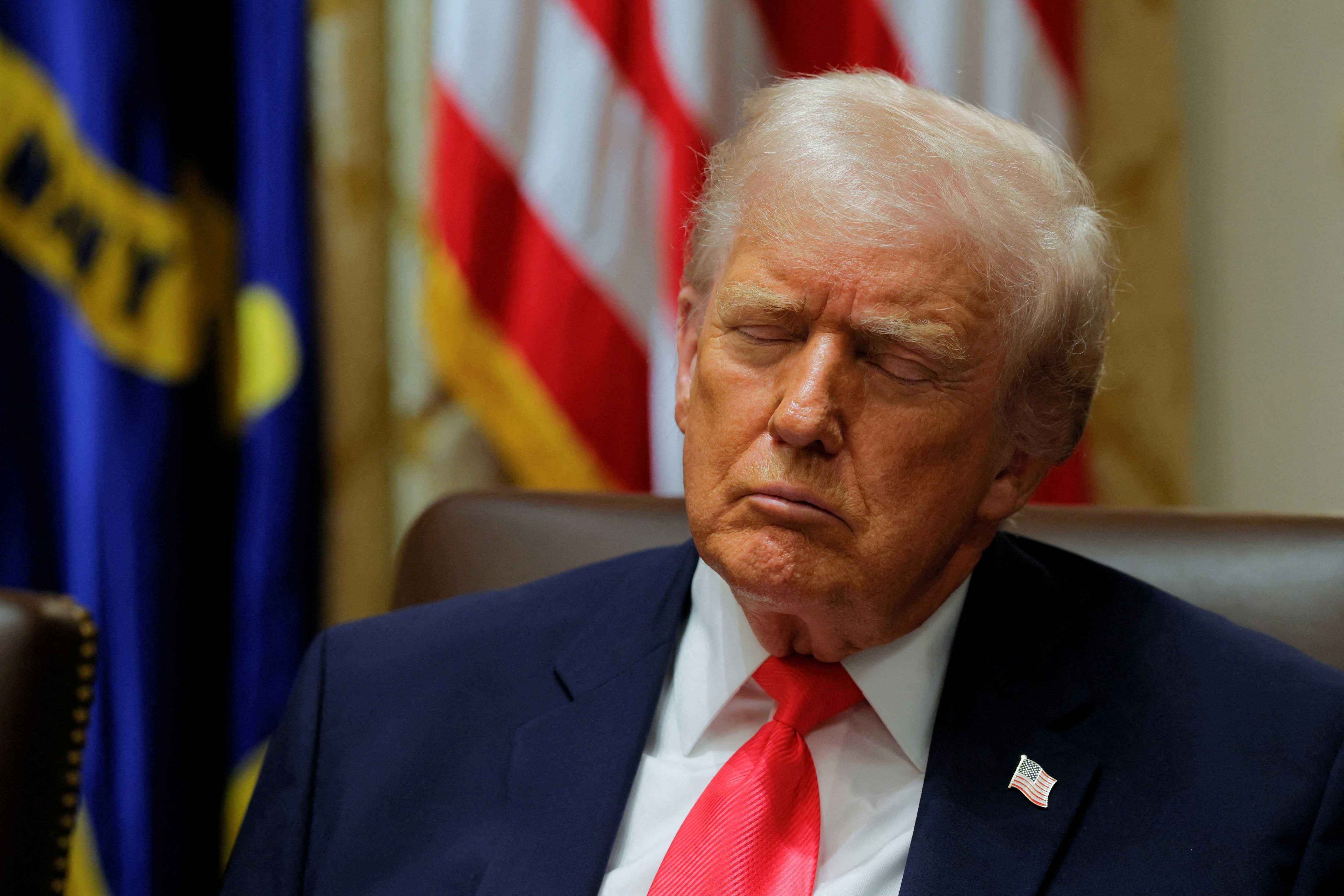
U.S. President Donald Trump attends a cabinet meeting at the White House in Washington, D.C., U.S., December 2, 2025. REUTERS/Brian Snyder
New York Times Colunist and podcaster Ezra Klein asked two people familiar with the Trump White House and past administrations to describe how the late-night diving and social media-obsessed President Donald Trump spends his days.
“He wakes up late,” said Atlantic staff writer Michael Scherer. “[Former President Barack] Obama would start work very early in the Oval Office and work until dinnertime, and then he’d go back to the residence. Trump comes down later in the morning. I think on an average day he’s in front of live cameras, if he’s at the White House … one to three hours in a day. … And I think the rest of the time is much more freeform. I don’t think the drive towards efficiency and structure is something that interests him.”
“He plays a lot of golf on the weekends,” said Atlantic writer Ashley Parker. “He goes to his private clubs — Mar-a-Lago in the winter, [or his New Jersey private golf club] Bedminster sometimes when it’s nicer — where he holds court. … But it’s much more of a rolling conversation than it is a meaningful policy debate in the traditional sense.”
Parker added that Obama ran his White House like the constitutional law professor that he once was.
“If [Obama] was doing something on trade, he would want to hear all different inputs in a very structured way from economic experts, etc., etc., all the relevant people. Then he’d synthesize all of that very granular information and make a decision,” said Parker. “When you look at some of Trump’s trade [policies], which sometimes are announced — like much in his administration — in the middle of the night on Truth Social, that may not have been vetted by anyone.”
“It’s just ‘tariffs against French Champagne because I’m angry at [French President Emmanuel] Macron,’” added Parker. “Agree or disagree that that’s a good way to lead a country, but you don’t need a rigorous policy process for that if the next day, you’re just going to undo all of those tariffs because something else has changed.”
“He doesn’t need to read the source material,” said Scherer. “He doesn’t need to go back through the history of things. Bill Pulte, who runs the Federal Housing Finance Agency … will come into the Oval Office with posterboards. I’ve been in the Oval Office in the first term and seen briefing documents for President Trump about a policy that’s basically 100 words on a page — just bullet points that are not detailed. It’s like, ‘here’s the five sentences you need to know about this thing before you make a decision.’ Not ‘here’s the 500 pages you need to know.’”
“When Obama did health care reform … Obama understood that bill. I don’t think Trump has the same level of understanding of the Big Beautiful Bill. I mean, he knows there’s no tax on tips, but he doesn’t know exactly what the SALT compromise was.”
“He knew it was big and beautiful,” added Parker.