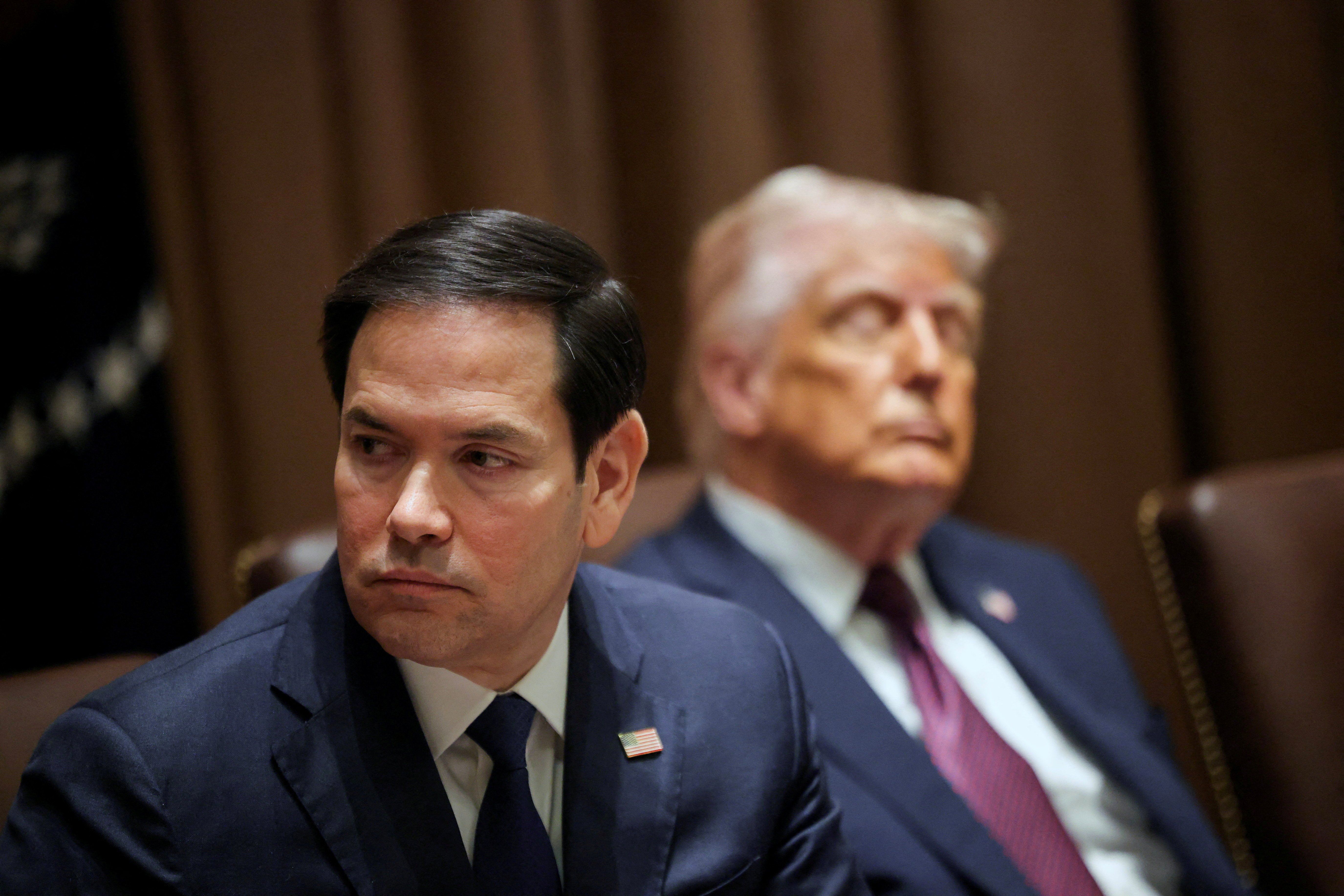
FILE PHOTO: U.S. President Donald Trump and Secretary of State Marco Rubio attend a cabinet meeting at the White House, in Washington, D.C., U.S., March 24, 2025. REUTERS/Carlos Barria/File Photo
President Donald Trump and his administration are “really freaked out” as it becomes increasingly clear that the US could lose hundreds of billions in Gulf Arab investments as a result of his unprovoked war against Iran.
“What has really freaked people out is that the Gulf Arabs have warned that they’re a couple weeks away from having to repatriate tens of billions of dollars in investments from the United States,” someone familiar with internal conversations at the White House told Politico. “When these guys do that, it is going to be immensely destabilizing and contradictory to the president’s investment goals.”
Although Trump facilitated hundreds of billions in Gulf Arab state investments in U.S.-based tech startups, investment firms and big businesses — many of which already heavily relied on those countries anyway — all of that is in danger if Iran continues to keep the Strait of Hormuz effectively closed.
“Any pullback on investments from Middle Eastern governments will limit the amount of capital available to that have come to rely on the region’s sovereign wealth funds and government-backed investment vehicles as a key source of cash,” Politico reported. “But the effective closure of the Strait of Hormuz has largely choked off oil and gas revenue that support Gulf-based financial institutions that are a major source of global capital.”
Politico added, “And Iran’s attacks on critical infrastructure and flashy highrises have brought tourism to high-dollar destinations like Dubai and Doha to a standstill.”
Writing for AlterNet earlier in March, journalist John Stoehr also observed a sense of “panic” in the White House, especially as it becomes clear that other nations are not going to readily come to bail the US out of it Iran quagmire.
“He said ‘hopefully’ other nations like China, Japan, South Korea, France and the UK would send warships to secure the strait,” Stoehr wrote. “By Monday, he was threatening allies in Europe. ‘It will be very bad for the future of NATO’ if they do not join the effort, he said. Just three days prior, he admitted to knowing that NATO’s enemy, Russia, was helping Iran. He rewarded that effort by lifting sanctions on Russian oil. Perhaps as a result, NATO allies told him you’re on your own.”
As one White House source admitted to Politico, “[The Iranians] hold the cards now. They decide how long we’re involved — and they decide if we put boots on the ground. And it doesn’t seem to me that there’s a way around that, if we want to save face.” Another source said: “The terms have changed. The off-ramps don’t work anymore because Iran is driving the asymmetric action.”
Even Trump’s fellow Republicans in Congress, who normally are loyal to him, admit to “frustration” with the progress of America’s military campaign there.
"The reaction to the closed-door briefing is the latest example that cracks are emerging among congressional Republicans over the Iran war as lawmakers are growing increasingly skeptical about spending billions of dollars to prolong the conflict," CNN reported earlier in March. "Several Republicans have said they will refuse to support any more money for the war without a clear White House strategy."
“There was no plan, no strategy, no endgame shared and they didn’t give any answers," an anonymous official later told NBC News. "It’s unclear if there isn’t a plan or if there is a plan and they wouldn’t share it with members."