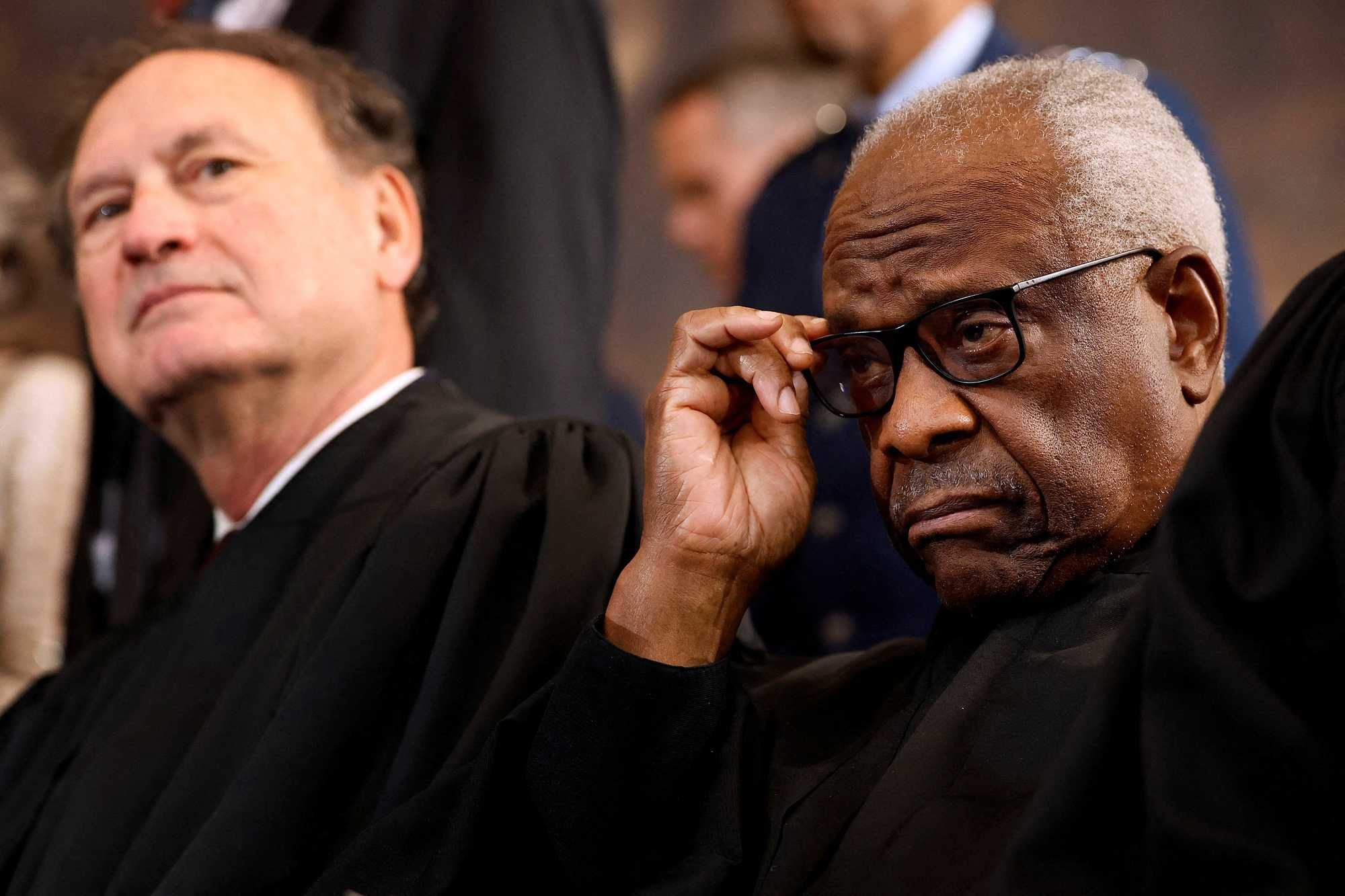
U.S. Supreme Court Associate Justices Samuel Alito (L) and Clarence Thomas on January 20, 2025 in Washington, DC. Chip Somodevilla/Pool via REUTERS
When Justice Clarence Thomas joined the U.S. Supreme Court in 1991, he had strong disagreements not only with the liberal justices, but also, with Ronald Reagan appointees Anthony Kennedy and Sandra Day O'Connor. Kennedy had a libertarian approach to conservatism, embracing a right-view of economics but voting with the High Court's liberal justices on cases involving gay rights and abortion.
Thomas, however, had an ally in Justice Antonin Scalia (Reagan's most socially conservative High Court appointee), and Justice Samuel Alito was often described as Thomas' kindred spirit after then-President George W. Bush appointed him in 2006.
According to analysis from SCOTUSblog's Kelsey Dallas in July 2025, Thomas and Alito "agreed in 97 percent of all cases resolved with opinions from the Court and in 100 percent of the closely divided (6-3 or 5-4) ones in the 2024-25 term." But Reason's Damon Root, in an article published on April 23, describes a rare example of Thomas and Alito finally having a major disagreement.
The case that found the far-right justices on opposite sides was Hencely v. Fluor Corporation,decided on April 22.
"It originated with a suicide bombing carried out by a Taliban operative at the U.S. Bagram Air Base in Afghanistan," Root explains. "Army Specialist Winston Hencely was severely injured in the attack and later filed suit for negligence in state court against the Fluor Corporation, the U.S. military contractor that employed the bomber. In its own investigation of the matter, the U.S. Army faulted the Fluor Corporation for, among other things, 'an unreasonable complacency by Fluor to ensure Local National employees were properly supervised at all times, as required by their contract.' The question presented by the case was whether Hencely's state lawsuit may proceed or whether it is preempted by federal law."
Root continues, "Writing for the majority, Thomas held that Hencely's state negligence suit may move forward. 'No provision of the Constitution and no federal statute justifies that preemption of the State's ordinary authority over tort suits,' Thomas wrote. 'Nor does any precedent of this Court command such a result.'"
Hencely v. Fluor was a 6-3 ruling, with Thomas joined by the High Court's three Democratic appointees (Justices Sonia Sotomayor, Elena Kagan and Ketanji Brown) and two Donald Trump appointees (Neil Gorsuch and Amy Coney Barrett). The dissenters were Alito, Chief Justice John Roberts and Trump appointee Brett Kavanaugh.
"What a fascinating line up," Root comments. "Not only do we have the rare sight of Thomas butting heads with Alito, but we have Thomas joined by all three Democratic appointees, while Alito has mustered the votes of only Roberts and Kavanaugh. In this case, as in certain others, the principles of federalism helped to make for some unusual judicial bedfellows."
Root argues that "Alito basically accused Thomas of letting federalism run amok to the detriment of the war powers of the national government."
The libertarian journalist notes, "'May a State regulate security arrangements on a military base in an active warzone?' Alito demanded. 'May state judges and juries pass judgment on questions that are inextricably tied to military decisions that balance war-related risks against long-term strategic objectives? In my judgment, the answer to these questions must be no, and for that reason, this state-law tort case is preempted by the Constitution's grant of war powers exclusively to the Federal Government.'"