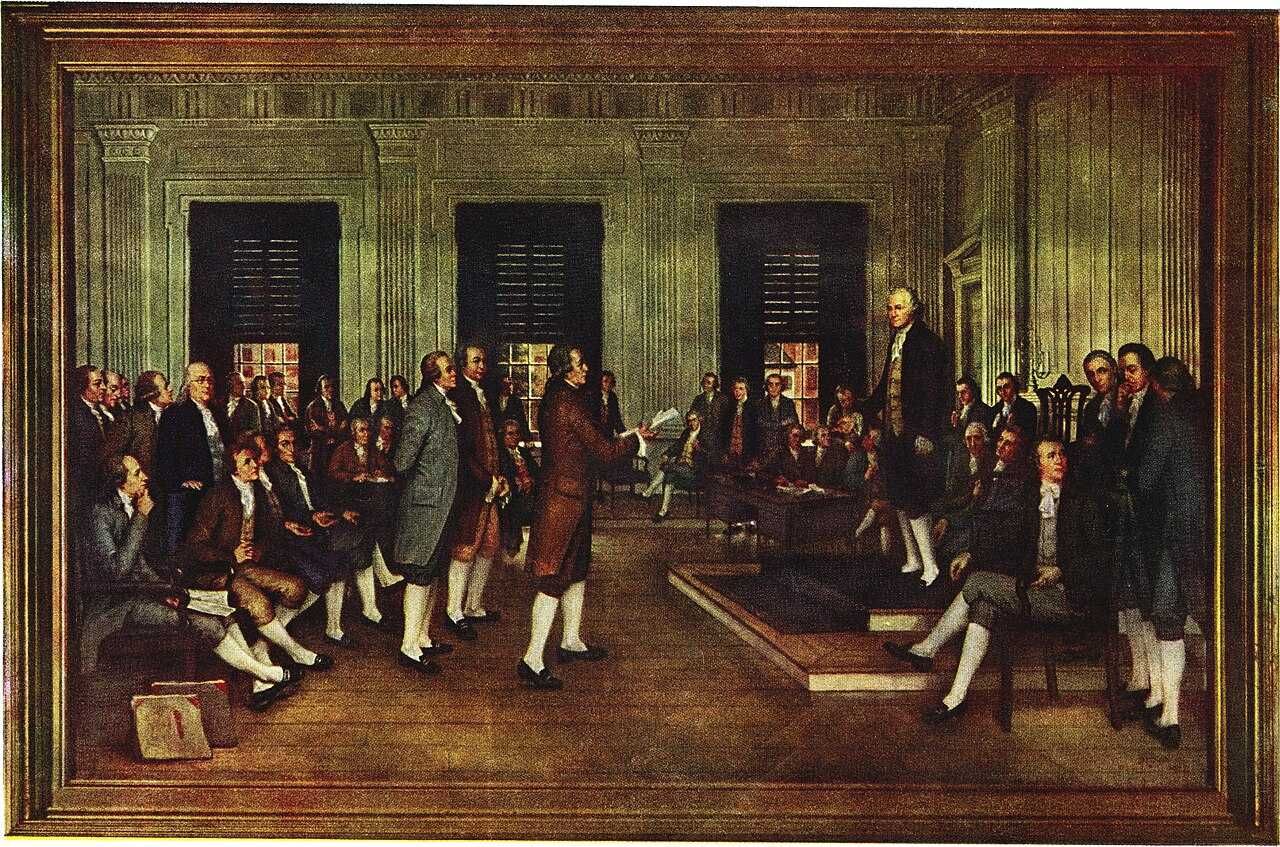
Far-right Christian nationalists, from Defense Secretary Pete Hegseth to The Heritage Foundation's Kevin Roberts to Pastor Doug Wilson, are claiming that the United States was designed to be a "Christian nation." This isn't a new argument: the late Rev. Jerry Falwell Sr., founder of Liberty University and the Moral Majority, claimed, during the 1980s, that the "separation of church and state" argument was designed by Satan to keep Christians from running their country.
Hegseth, Roberts and Wilson are claiming that the United States' Founding Fathers envisioned a government run by strict Christian fundamentalism. But the First Amendment to the U.S. Constitution never mentions Christianity and specifically states, "Congress shall make no law respecting an establishment of religion, or prohibiting the free exercise thereof."
Liberal opponents of Christian nationalism, including the American Civil Liberties Union (ACLU) and People for the American Way, argue that while the First Amendment's Establishment Clause is protective of one's right to practice Christianity, it is equally protective of other religions — or, for that matter, atheists and agnostics.
Historian/religious scholar Gregg Frazer, according to the Independent's Peter Smith, now finds himself "at the center of" the debate on Christian nationalism. And Smith, in an article published on May 3, notes that this debate is taking place ahead of the United States' 250th anniversary.
Smith quotes Frazer as saying, "Neither side really wants to hear what I say." Frazer believes that the Christian nationalist view of U.S. history is inaccurate, as the Founders didn't envision a fundamentalist theocracy but weren't anti-religion either.
"He emphasizes that most Founders were religious in some capacity," Smith explains. "This longstanding debate over the Founders' religious intentions has gained renewed intensity with the approaching 250th anniversary of the Declaration of Independence on July 4. Amid the 'America 250' celebrations, some Christian activists and authors are intensifying their claims that the U.S. was founded as a Christian nation. This narrative finds support from the current administration, with President Donald Trump promoting 'America Prays,' culminating in a May 17 gathering on the National Mall in Washington."
Smith adds, "Cabinet officials have also issued Christian messages in their official capacities, with Defense Secretary Pete Hegseth proclaiming that 'America was founded as a Christian nation.… in our DNA.'"
Smith cites Americans United for Separation of Church and State as an example of a group that is pushing back against Christian nationalism, saying, "Most — nearly all — serious historians agree that America was not founded as a Christian nation in any meaningful legal, philosophical or constitutional sense."