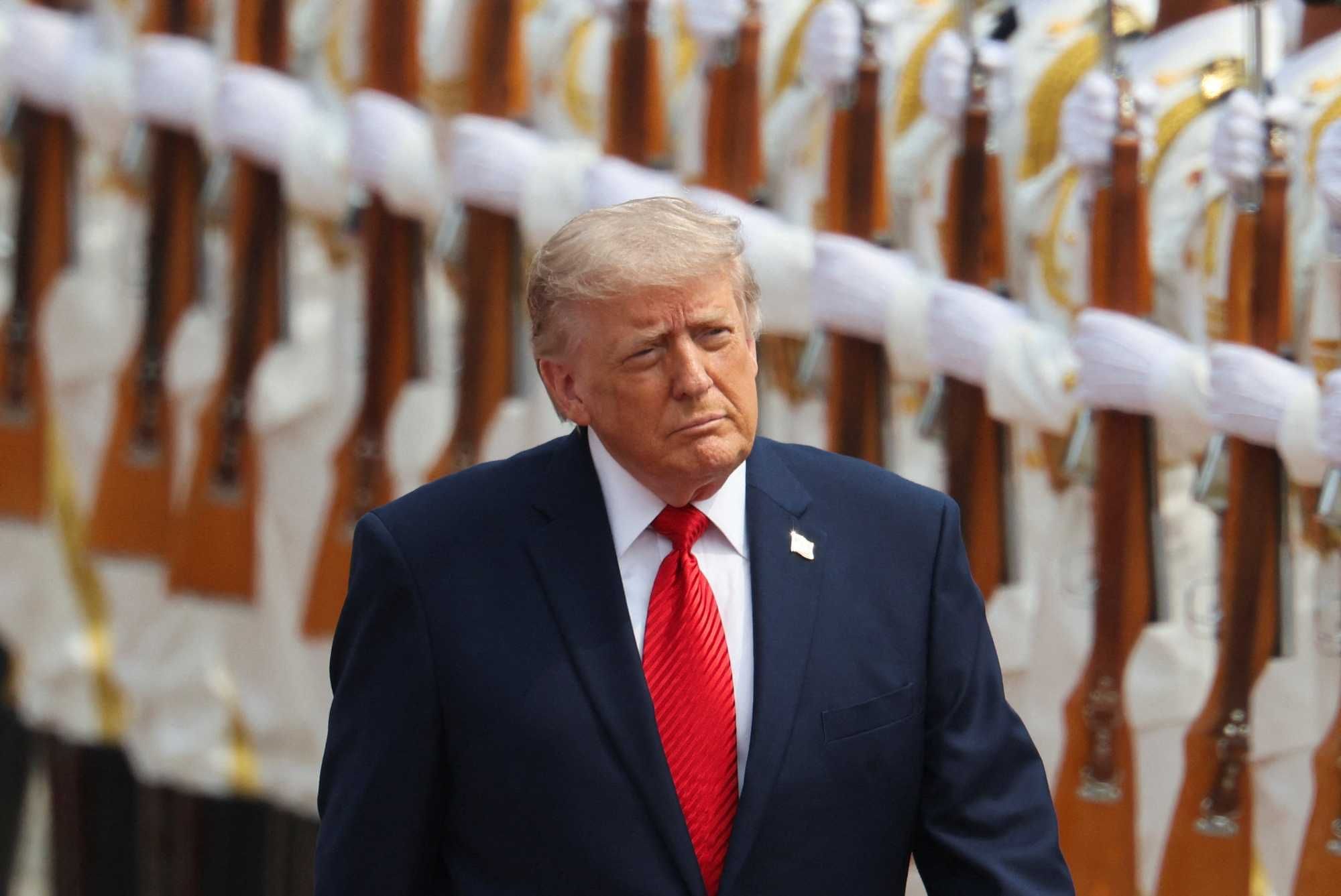
Trump calls the entourage of 12 CEOs accompanying him to China an “incredible gathering” of America’s “Greatest Businessmen/women.”
Well, it may be an incredible gathering. But to characterize them as America’s greatest business leaders — who are assumed to be leading America’s competitive charge against China — is misleading.
The American CEOs traveling with Trump to China don’t think of themselves as being in competition with China. In fact, they’d like nothing better than to make more money for themselves and their shareholders by setting up more lower-cost, highly productive factories and research facilities in China and hiring more Chinese talent.
It’s an important distinction. The CEOs of Chinese companies are in business not only to make money but also to strengthen China’s geopolitical power in the world. The CEOs of American companies want to make gobs of money, of course, but they couldn’t give a rat’s ass about strengthening America’s geopolitical power in the world.
This basic difference is airbrushed away in breathless media stories about the competitive race between the American and Chinese economies — the so-called “race for supremacy” in AI, advanced semiconductors, supercomputers, solar wafers, biotechnology, and other industries of the future.
The distinction never appears in the breezy press coverage of Trump’s trip to China, along with his “U.S. corporate” delegation.
Take Elon Musk, obviously a conspicuous presence in Trump’s CEO delegation. Musk’s Tesla Gigafactory Shanghai produces over a third of Tesla’s global car sales. It’s also Tesla’s most productive factory. In February 2025, Musk opened a second factory in Shanghai, a $200-million plant focused on producing Megapack batteries. Nearly 40 percent of Tesla’s entire battery supply chain relies on Chinese companies.
All good for Musk and for Tesla shareholders, but what about American workers, who aren’t getting this work? What about America’s national security, which could be compromised if China gains further global dominance over batteries (as well as other renewables)? Do you think Musk cares?
Or consider Apple’s Tim Cook, also in Trump’s CEO delegation. China has become the gravitational core of Apple’s supply chain. Indeed, much of Apple’s success is due to Cook’s move to consolidate virtually all of his company’s manufacturing in China. About 90 percent of iPhones are assembled there, backed by massive investments in local supplier expertise and infrastructure. Cook explains that he’s taking advantage of China’s “unmatched” expertise in advanced tooling and manufacturing.
Since 2008, Apple has worked with Chinese suppliers to train 30 million workers there and has transferred practical engineering knowledge of how to make complex things from American engineers to thousands of Chinese engineers in hundreds of Chinese factories and research centers. Apple’s Cupertino, California, headquarters has sent so many American engineers to China to teach Chinese engineers that it even persuaded United Airlines to schedule three weekly flights from San Francisco to Chengdu and Hangzhou.
A third CEO in Trump’s delegation is Jane Fraser, CEO of Citigroup. Her goal has been to expand the bank’s (and its clients’) investments in China by growing Citigroup’s team in China and capturing market share for the corporation in high technology and advanced manufacturing.
Fraser’s moves may be good for Citigroup’s bottom line, but they may not be good for America. As she connects international investors with opportunities within China, she may be siphoning off potential investments in high technology and advanced manufacturing in the United States.
Another American CEO in Trump’s delegation is Jensen Huang, CEO of Nvidia. Huang’s goal is to get China to buy Nvidia’s AI and its advanced H200 processors, even at the risk that Chinese computer scientists and engineers might reverse-engineer them, as they have so many other technologies America once dominated.
Huang argues that with roughly half of all the world’s AI researchers, China is strategically vital for American tech companies. Huang may be right, but what’s strategically vital for American AI companies may not be in the strategic interest of the United States. The capacities that increase these corporations’ profits and returns to their American investors (including the pay packages of their CEOs) do not necessarily increase the productivity, knowledge, or strategic strength of America’s AI.
Doesn’t Trump know this? Does he assume that the rest of us don’t know? Is he really ignorant of the fact that Chinese corporations are tethered to China, but the CEOs of Tesla, Apple, Nvidia, and other so-called “American” corporations are not strategically bound to America? American CEOs aren’t paid to worry about the competitiveness of the United States, nor the number of good jobs in America, nor even about American national security.
Maybe Trump knows all this but doesn’t care. When it comes to making big money doing global deals, Trump’s merry band of CEOs has about as much loyalty to the United States as does Trump himself.
Robert Reich is a professor of public policy at Berkeley and former secretary of labor. His writings can be found at https://robertreich.substack.com/.