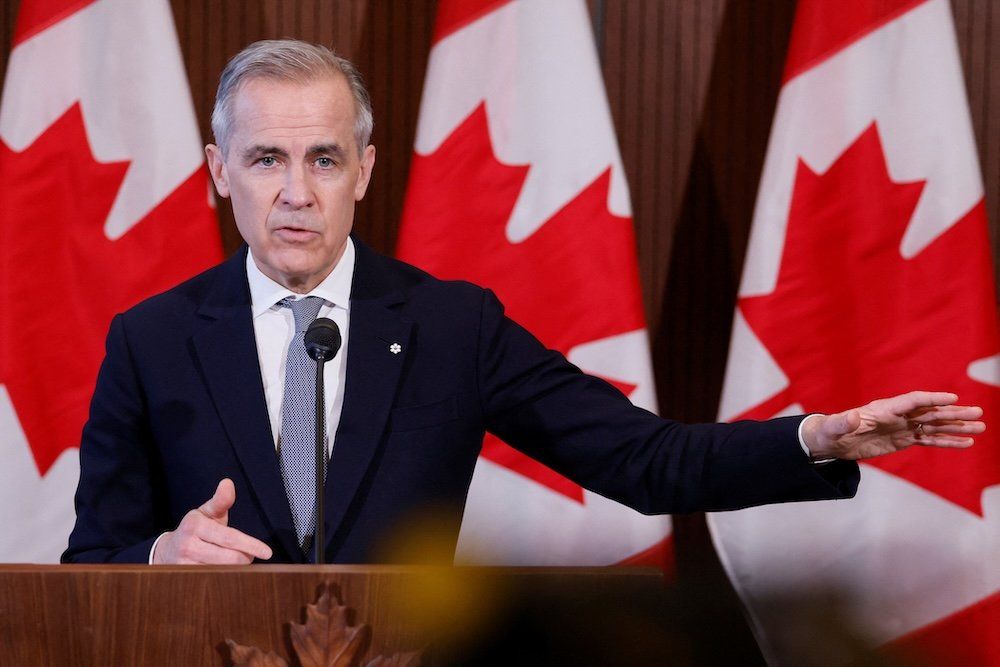
The United States has been so close to its northern neighbor Canada that, only a few years ago, it was unimaginable that millions of Americans would call to annex that country. Fewer still could have imagined the president himself saying Canada should be America's "51st state" and meddling (amidst great controversy) in favor of a secessionist movement attempting to take control of the Canadian province of Alberta.
Has the United States returned to the 19th century, when Americans urged a Democrat, President James K. Polk, to fulfill his 1844 campaign promise and annex Canadian land in the Pacific Northwest all the way to the 54°40′ parallel north? During the Oregon boundary dispute (when Canada was controlled by the United Kingdom), the slogan was "Fifty-four Forty or Fight!" Now supporters of a Republican, President Donald Trump, are following the president's whims rather than a campaign promise. It is essential to note that, whereas Polk (a) dealt with a genuine grassroots movement and (b) handled his demands competently (the Oregon Treaty of 1846 extended America's border westward along the 49th parallel), Trump's bullying of Canada began entirely out of his own obsessive trade wars (one which trade policy expert, Dr. Ed Gresser of the Progressive Policy Institute, told AlterNet were so difficult to trace to their origins as to be "weird").
Nevertheless, when Trump trollishly bullies Canada by calling it America's 51st state or renames Lake Ontario, millions of his supporters go along with him.
To better understand what all of this means for the present state of US-Canada relations, I spoke with Dr. Stephen M. Saideman, Paterson Chair in International Affairs at Carleton University. The following interview has been lightly edited for clarity, context and length.
"The best way to insult Canadians."
Matthew Rozsa, senior editor at AlterNet: How have Canadians' permanent perceptions of Americans changed as a result of President Trump doing three things: A, his tariffs; B, his insults; and C, his threats of annexation and meddling with Albertan secession?
Stephen M. Saideman, Paterson Chair in International Affairs at Carleton University: I'm not sure "permanent" is the right word, because I don't know how much of this will last beyond Trump. But I do think that we now see Canadian nationalism at its highest point in decades and decades, that Canadians are very, very angry about Donald Trump, particularly the 51st state stuff. We had tariffs last time, and so Canadians were aggrieved last time, but they weren't as angry. The best way to insult a Canadian is to tell them they're just cold Americans — that they're Americans who live north of a border. They think of themselves as being a different people, and Trump focusing on the 51st state stuff has been the key point of aggravation.
Rozsa: Do they feel this way because they fear America is actually going to try to annex them?
Saideman: I think there's a fair amount of people who think that, but I think it's more just the insult — you're insulting Canadian identity. Canadians don't agree a whole lot. I've often joked that the only things that unify Canadians are hockey, the belief that they invented peacekeeping and the smug sense that their healthcare system is better than the American one. But there's a fourth one, which is they all can agree they're not Americans. So when you have Quebecers standing up alongside Carney, that says something. The Albertan separatism thing is actually fairly toxic in Alberta, because if you're an Albertan separatist, you're sort of lining yourself up with Trump, and that makes it unpopular. He is widely reviled across the country because he's basically telling people that they are Americans, and that's not something that they want to hear.
Rozsa: Hypothetically, if Trump did either invade Canada or in some way provably help Alberta secede, what would the reaction be from ordinary Canadians?
Saideman: Well, I think the second one is more likely, so let's go with that. If Trump helps the division of Canada, then it'll be very unpopular, because it would be seen as being akin to war, really. If Trump is dividing Canada, doing something like that — as angry as things are now, they'd be even angrier.
Rozsa: That's literally what prompted President Woodrow Wilson to involve America in World War I. The Zimmermann Telegram revealed that the German Empire had been in talks with Mexico to return to it the territory it had lost during the Mexican-American War if Mexico would side with the Central Powers. Did you know that?
Saideman: Well, I am familiar with that argument. I don't think that's entirely why Woodrow Wilson got involved in the war. But I would say that, yeah, the Canadians would be outraged.
Rozsa: You don't agree that the Zimmermann Telegram is why he got involved?
Saideman: I think it was one of the reasons why they got involved. I don't think it's the reason they got involved.
Rozsa: It was certainly the primary immediate catalyst.
Saideman: Well, for today's conversation, the key is that if Trump were to be visibly abetting Albertan separatism that actually succeeded, it would cause Canadian-American relations to approach War of 1812–level kinds of hostility. It wouldn't be war, but right now Canadians are reluctant to travel, they're reluctant to buy American goods. They would double, triple down on that. You wouldn't see any Canadians traveling in the United States, and you'd see people being very hostile to anybody buying anything that is remotely American.
Rozsa: I agree with your anticipation about the future, but I want to push back a little in terms of what we just discussed regarding the past — not in terms of whether the Zimmermann Telegram was the primary immediate catalyst for America's entry into World War I, but rather because there are other occasions from American and Canadian history that can be used to understand the impulses of the present moment. Another one that comes to mind for me is "54-40 or Fight." When the Democrats ran for president in 1844, their nominee, James K. Polk of Tennessee, a former speaker of the House, adopted as his platform "54-40 or Fight" — the idea that, among other things, America would take part of what is now Canada in the Pacific Northwest.
Saideman: Yeah, that's not in anybody's living memory, so it doesn't have a lot of resonance on either side of the border at this point in time. Trump very clearly did not run for election in 2016 or 2024 based on animus to Canada. He wasn't mobilizing anything about Canada in the United States. This is one of those things where his fans — 30 percent now, 25 percent, whatever his support base is these days — will go along with it. They'll clap along with it. He had Alaskans [booing] Canada, but it wasn't all Alaskans; it was just the folks who show up at his rally. Just like a couple days before, or maybe the day before, he had them clapping when he said they're stupid enough to applaud him insulting them, or whatever it was.
And so there aren't any real domestic political grievances that Americans have towards Canada. So I don't think this will last beyond Trump. It's just not something that Americans really care about. The way I always tell Canadians how Americans think about Canada is: Take a look at the weather map during the evening news. Canada isn't there. The line just stops, and there's empty space above it. That's the way Americans think about Canada. So it's not something that's mobilized support for Trump or for a Trump replacement or successor. It's just something that he's fixated on for a variety of reasons, and it's not something that resonates really amongst either the American people or anywhere else.
"Common interests."
Rozsa: Here is where I need to push back, and I'm doing so with the historical examples I brought up earlier. I believe that you can best understand the present by looking at historical antecedents. In terms of "54-40 or Fight," it shows that Americans are capable of expressing open animus toward Canada, and thus Trump's rhetoric and even his meddling in Albertan politics has some basis — some root, if you will — in America's national character. And I bring up the Zimmermann Telegram because America entered a world war because of a provocation certainly analogous to what we are now doing with Alberta. So I bring these up to illustrate that there is a history of things reaching a boil between the US and Canada — of there being, at the very least in the short term, significant breaches and hostility. So when you say you think everything will reset once Trump is gone, who is to say that things won't get worse, like they did in those eras, even after Trump is gone? Your response seems to be that Americans don't really care that much. How do you know?
Saideman: How do I know? Well, first of all, Trump's approval rate is really low right now. It's 30 percent. So it's not like there's this groundswell of support for this. In no survey has there been a lot of support for this. The last survey I saw, like 38 percent of Republicans have registered some animus towards Canada in the aftermath of the trading agreement breaking up. But Republicans are not half the American population. So 38 percent of Republicans is not a huge metric for wide support for provoking conflict with Canada. So my big comebacks to you are a couple things. One is, Trump is ahistorical. Trump is not a natural evolution of American politics and its policies towards Canada. There's no straight line between the 1840s and now. We had a hundred years of uninterrupted bliss between the United States and Canada, from the 1930s till now.
And so there's not, again, a groundswell of the population caring about this. The common interests between the countries, the common values between the countries, overall militate against anything really lasting beyond Trump. Will there be some folks who try it? Sure. JD Vance may try it, but JD Vance doesn't have the same power to summon support from people who are near cultists. So it's just not something that really resonates with the American people. This is his particular obsession, and it's not something that was even a far-right-wing kind of cause before this. In 2016, I was skeptical about Trump being critical of NATO, because I didn't think anybody cared about how that would affect people's votes, but that was signaling to the right wing that he was opposed to international organizations and all that kind of thing.
There's nothing here. There really isn't. And that's why Americans don't take it seriously. They laugh about it because they just don't think it's very serious. The Canadians take it very seriously, but the Americans don't, because to them it's a joke. They don't see any real differences that would cause one to think we need to go to war with them. It just doesn't resonate.
Rozsa: I have two follow-ups to what you just said. First, you assume that when Trump is gone, there won't be people in his cult who follow his teachings — among which is now that America should own Canada — and therefore pose a problem for Canadians in the political future. How can they be confident that another Trumpist won't rise to power after Trump himself is gone? That's my first rebuttal. But while you have that in mind, my second question: You're not taking into account the possibility that, regardless of who follows Trump, Trump will be in power likely for another two years and can do a lot with those two years.
Saideman: Oh, the Canadians and I are all very worried about the next two years. There's no doubt that Trump will continue to coerce Canada. So yes, the next two years are going to be unpleasant. So the second question's really easy to answer. It's not going to be fun. This level of tension is going to go on until... I mean, the one thing that may happen — and I think this is actually a fairly likely outcome — is Trump will be desperate for some kind of deal to prove that he's still a dealmaker. And so he'll go back and basically say, "Carney, we'll make a deal." Carney will say, "Okay, we'll give you a deal where we don't actually sacrifice anything." And they both can claim victory for it. And then the conflict ebbs.
People forget that in 2018, Trump was near the edge of having a war with North Korea. And all he wanted was a deal. And so he went and met with Kim Jong Un. All Kim Jong Un wanted was to be recognized as an equal to the United States president. So Trump tossed away that bargaining chip. And what did Trump get out of it? Nothing. He could claim that he'd made progress in denuclearizing the peninsula, but nothing happened. He just wants to declare a deal. And so at some point, Trump may realize that the easiest way to declare victory is just to say there's been a deal made — that Canada will buy American weapons systems, and the level of tariffs that were initiated will be reduced to something a little bit less than they are, but not go away.
And he can say he's protected the American market from Canadian goods. Canadian politicians can claim, "We settled the deal for now, and if Trump pulls out of it, then we can pull out of it." So that isn't the likeliest thing, but I do think that we're in for two more years of pain.
"Others will follow his teachings."
Rozsa: What about my first question?
Saideman: The thing is this —
Rozsa: There will be Trumpists. There will be others who follow his teachings.
Saideman: There'll be competition. There'll be competition for people to try to be the next king of the MAGAverse, right? That's going to happen. But is this the issue that they're going to use to whip up support? Not if there's no American constituency for it. They'll find other things. They'll go back to immigration. They'll go back to racism. They'll go back to misogyny. They'll go back to their core issues where they can get some support. Again, Canada just doesn't matter to most Americans, not even the far right. And so they can try to whip it up, but it will flop. Trump is not getting any boost in his popularity by beating up on Canada. It's not helping him with his base, and it's not helping with anybody else.
Rozsa: All right. I'm going to move on to the next subject. I'm asking not just about their opposition to current policies, but how they feel about America culturally. How have events with Trump during his second term alienated ordinary Canadians from the United States in ways that were not true, for instance, when they simply disagreed with the president's policies, like George W. Bush during the Iraq War?
Saideman: Well, I think you'd also compare Trump One versus Trump Two, because Trump One was annoying, but not like this. So I think the Canadians will be suspicious about American politics from now on, because they've seen the American political system break down over this — that it's not operating the way it should. So there's going to be less respect for the United States. There's going to be less respect for American foreign policy, and more looking towards cooperating with other countries to reduce dependency on the United States. I think the United States has lost a lot of political capital in Canada. I do think that Canadians understand the United States better than most other countries understand the United States, so they tend to separate Trump from the Americans they deal with.
The only Americans who have been harassed in Canada have been the ones wearing obnoxious T-shirts, talking about Lake America and all that kind of stuff. Otherwise, Americans moving to Canada — they apologize for Trump, and then the Canadians welcome them. So I don't think that Canadians are going to hate Americans. And I don't think Canadians are going to stop consuming Hollywood or other pop culture stuff. But the American government's not going to be trusted anytime in the near future.
Rozsa: Are there any benefits to what has happened in terms of Trump and America's relationship with Canada?
Saideman: Benefits to who? Canada and the Canadians, or the Americans?
Rozsa: Either. Both.
Saideman: Okay. So it's been entirely costly for the Americans. They haven't gotten anything out of Canada for this, and they've proven that they'll beat up on friendly allies. So I think that raises the costs for them internationally, across the world. For Canada, well, Trump has helped them avoid having [their own] Trump, right? In 2024, every incumbent across the planet lost their elections, with a couple of notable exceptions. And so there was a real possibility that the Conservatives in Canada would win in 2025, but that election happened two or three months after Trump's very fast start, where he and DOGE and Musk and everything else were blowing up everything in sight. And so it caused Canada to swerve away. A very populist potential government was defeated partly because Canadians were like, "We don't want this. We see what's going on in the United States." And so Trump saved us from Poilievre to a certain degree, and that was good for Canada.
You have much more Canadian unity at this moment in time, which I think is mostly good. Canada has a bit more influence in the world, as Carney's become the voice of the resistance. People care about Canadian foreign policy — you see countries lining up to hang out with Carney, because he's got more influence, because he's been willing to speak out and do real things, like back away from the trade deal. So that helps. And it hurts Canada in that I think Carney's getting away with a lot of stuff domestically. He's the most conservative Liberal prime minister we've ever had, or at least as far as people remember. And that's not really good for a lot of issues. So it hurts Canada in that way. And the Canadian economy's taking a big hit from tariffs. So it's not been wonderful for Canada.
Rozsa: I guess my closing question has to involve whether you think the Canadian people, as a people, will have the same instinct of outrage at learning about Trump doing something like helping Alberta, or even Quebec, secede that the US felt during the Zimmermann Telegram. I don't mean to poke at the fact that you don't agree with my interpretation of World War I history, but I do understand that that was the tipping point which prompted Wilson to declare war. And if one accepts that premise, then could not Trump meddling in Canadian secession movements be perceived as an analogous affront?
Saideman: I think it would be really, really angering to the Canadian public. It will not cause the Canadians to declare war on the United States, because of the power asymmetry involved. We understand that Canada would pay a much, much higher price for war than the United States would. So it would not trigger a war.
Rozsa: Maybe not a war, but Canada has already made overtures to the European Union.
Saideman: Yes. Canada's diversifying its portfolio, its trade. This is something that's been going on for 20, 30, 40 years, where Canadians have been trying to open up other trade markets so they're less dependent on the United States. That's always been a thing. Now it's developed more of a political imperative. So yeah, they've grown closer to the EU. Would they join an alliance with China against the United States? No. That's the thing you should be asking — not about the EU, but about China. And that's not really in the cards, because China's values are counter to those of the United States and Canada. They've engaged in election interference. They've brutalized Canadians. So there's only so much cooperation we can have with the Chinese. So that would be the analogous situation — Canada switches alliances and hops on the Chinese bandwagon — and that's not going to happen.
Rozsa: And this is where I return to "54-40 or Fight." America always has had this notion that it has rights to Canada. Can Canada ever really trust America's intentions when, 180 years later, that spirit has been revived?
Saideman: It has not been revived. This is where you're just wrong. It's Trump and only Trump. This is not something that is popular with the American people.
Rozsa: Popular, no, but there is still a hardcore pro-Trump constituency that now refers to Lake Ontario as Lake America.
Saideman: That's because they're trolls. They like to p - - - people off. It has no real substance. It's not something that people are going to vote on. If you have four Republicans competing in the next presidential primary, and three are pro-Canada and one is anti-Canada, the anti-Canadian one's not going to get one more vote because of that position. It's just not resonant with the American public. This is not 1840. Things have changed over the past couple hundred years. You're interviewing me about this; this is my stance on it. You can write it up the way you want.
Rozsa: Oh, I'm not disputing that Trump is wrong on Canada in terms of public opinion. I'm saying that even though he is wrong in terms of public opinion, it doesn't matter, because he plans on acting like a dictator. And even if he is removed from power, the people who are in his cult — to use your term, although I've also used it quite often — are going to continue to promulgate his ideas, since that is what drew them to him.
Saideman: No. Again, I disagree, because other things resonate with this cult. This is not really anything of consequence.
From Your Site Articles
- 'Zero chance' latest Trump demand will matter outside of his administration ›
- The hidden trap inside Trump's latest attack on Canada that could backfire ›
- O, Canada: We’re doing everything we can to put Trump back in his cage ›
- Trump just ripped up the rulebook — and left Canada with only one choice ›
- Trump team lays groundwork as insidious blame game plan revealed ›
- 'A wake-up call': How Canada plans to insulate itself from volatile US politics ›
- Trump administration issues 'profoundly misguided' threat against Canada ›
Related Articles Around the Web