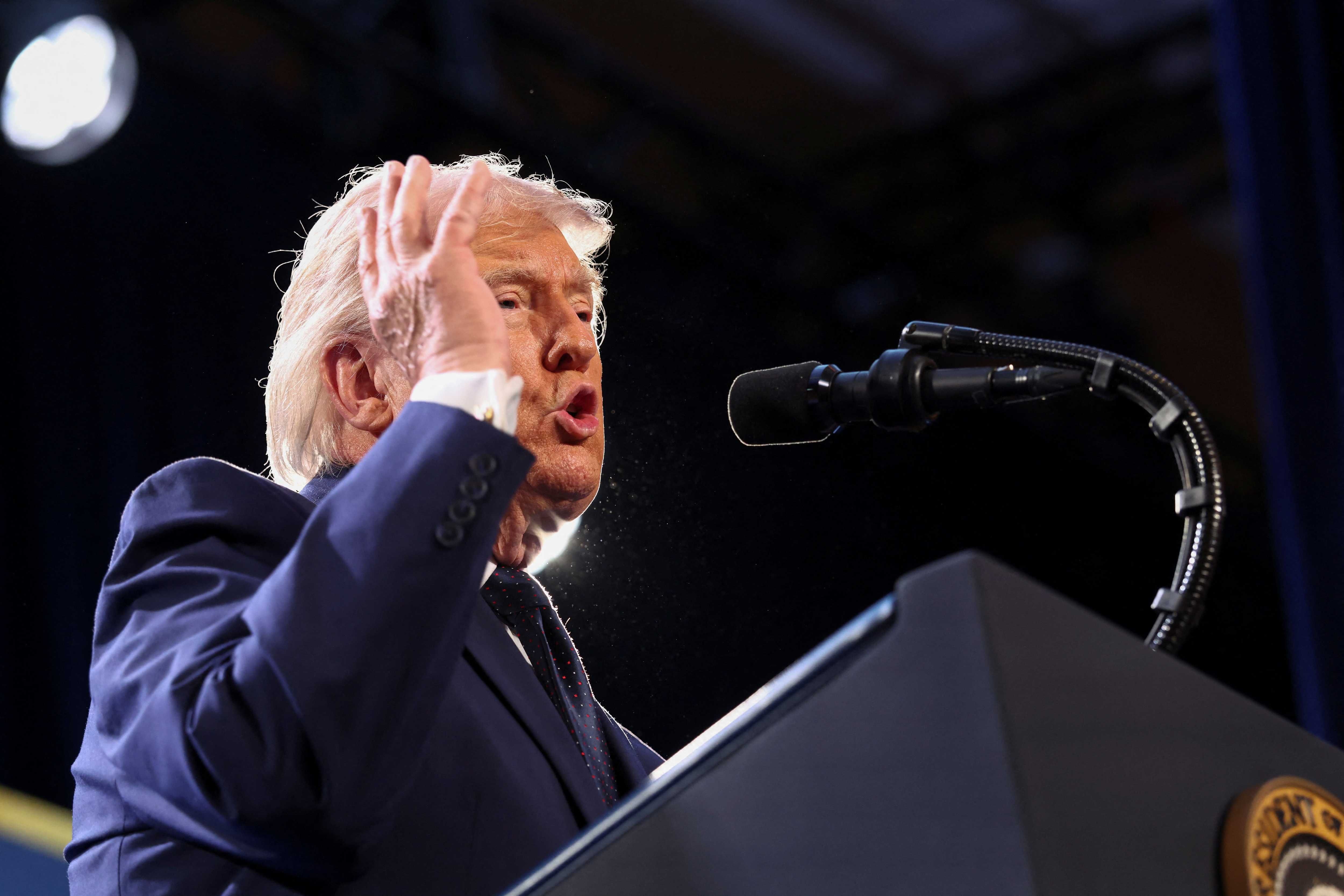
U.S. President Donald Trump delivers remarks to members of the Republican Party, at Trump National Doral Miami in Miami, Florida, U.S., March 9, 2026. REUTERS/Kevin Lamarque
When the U.S. sent troops into Iraq, 76 percent of Americans approved, after the President spent a year explaining why: First, Bush/Cheney sold the belief, even if contrived, that Iraq possessed weapons of mass destruction. Second, intelligence claimed that Iraq had close ties to al-Qaida, which was responsible for 9/11.
In Afghanistan, even more Americans—92%— approved of military intervention. Bush communicated a strong national security drive to destroy al-Qaeda training camps, remove the Taliban from power, and assist in creating a regime that would not incubate or harbor terrorist cells hellbent on harming Americans.
Throughout messaging on both campaigns, Bush skillfully showcased U.S. alignment with foreign allies. Bush brandished a coalition of more than 70 nations offering military assistance for both wars, including intelligence, airspace access, and troops for combat operations.
To the American public, solidarity among democratic allies signaled rightness of cause.
Trump didn’t bother with any of that
Fast forward to 2026, Trump, and the war-not-war in Iran.
On February 28, 2026, in the middle of the night, Trump released an 8 minute video announcing that the U.S. had already begun ‘major combat operations’ in Iran. He hadn’t pre-sold his war to Americans, suggesting disinterest in their buy-in. He hadn’t tried to sell the war to Congress either, suggesting fear of scrutiny.
Had a Constitutionally-required debate taken place, complexities involving the Strait of Hormuth, the logistics of global energy, and how attacking Iran would increase the price of oil would have surfaced. Instead, three weeks later, Trump has still not articulated non-contradictory reasons, or specific military objectives, for the war. So no one should be surprised that only 20% of Americans support sending in U.S. troops.
Trump insults allies then expects their support
Trump’s messaging failure at home is even worse among our allies. Just in January, Trump said NATO troops “stayed a little off the front lines” when helping the U.S. in Afghanistan, an outrageous insult not only to our allies, but to the memory of soldiers who perished there.
Trump, while consistently praising Putin, has a well-documented history of publicly insulting America’s allies: France’s Emmanuel Macronis “nasty,” and “nobody wants him;” Angela Merkel“ruined Germany;” Canada’s Justin Trudeau was “dishonest and weak,” then Prime Minister Mark Carney was the “future Governor of Canada.” He called Denmark’s Prime Minister “nasty” for rejecting his plan to purchase Greenland, and claimed he instructed the UK’s Theresa May“how” to effectuate Brexit, which proved disastrous for the UK’s economy.
The jabs and insults flew during his first term then morphed into an economically illiterate tariff diplomacy in his second term. He is now trying to alpha the world by imposing tariffs on American consumers.
Following his sophomoric and self-defeating attacks on our allies, Trump now “demands” their help in Iran.
The bully needs a favor
Now that oil has topped $100 a barrel, Trump needs our allies—the ones he harmed economically and insulted like an 8th grade bully—to send back up warships to the Strait of Hormuz, the passage for 20% of the world's oil. On March 14, Trump declared that other countries should secure the Strait even though he endangered it without first consulting them; he reiterated his petulant cry on March 16.
Trump also promised that the U.S. Navy would guarantee the safety of all maritime traffic in the Strait. Since the Strait remains closed to the US and our allies, it’s pretty clear the U.S. Navy can guarantee no such thing.
By Sunday night, Trump signaled that the U.S. could not go it alone, and threatened repercussions for countries that refused to help, telling reporters, “I’m demanding that these countries come in and protect their own territory, because it is their own territory.” He added the next day that, “The United States should not be very much involved” in the strait, asking illogically why we aren’t being reimbursed for the effort and the economic fallout he unilaterally foisted on the world.
Insulted allies are not moved
Most U.S. allies have responded to Trump's request for help in the Strait of Hormuz with yeah, but no.
Germany’s Defense Minister stated, “This is not our war; we did not start it.” Throwing Trump’s endless chest beating back in his face, he added, “What does Trump expect from, let’s say, one or two handfuls of European frigates in the Strait of Hormuz that the “powerful American Navy cannot accomplish?”
The UK’s Prime Minister said the UK “will not be drawn into the wider war” with Iran. The French foreign ministry said much the same, while the Polish foreign minister said that Poland had also “ruled out” sending forces into the conflict. Japan’s Prime Minister said there were no current plans to dispatch warships; Australia’s Transport Minister noted that Australia ‘is not contributing to this specific military effort.’ Spain also declined participation, labeling the conflict “illegal” while also banning U.S. aircraft from using joint bases in the war.
Consequences
Allied responses to Trump’s request hit home how grievously Trump has injured America’s standing in the world. Our relationship with NATO and other allies may never recover.
As the EU foreign policy chief put it, “This is not Europe’s war. Nobody wants to go actively in this war, and of course everybody is concerned what will be the outcome.”
It’s a shame Trump didn’t anticipate the predictable volatility of energy prices before he attacked Iran; it’s a shame he didn’t consult allies first. Mainly, it’s a shame Americans elected a president who doesn’t understand that a pugnacious bully will never have friends when he needs them.
Sabrina Haake is a columnist and 25+ year federal trial attorney specializing in 1st and 14th A defense. She writes the free Substack, The Haake Take.