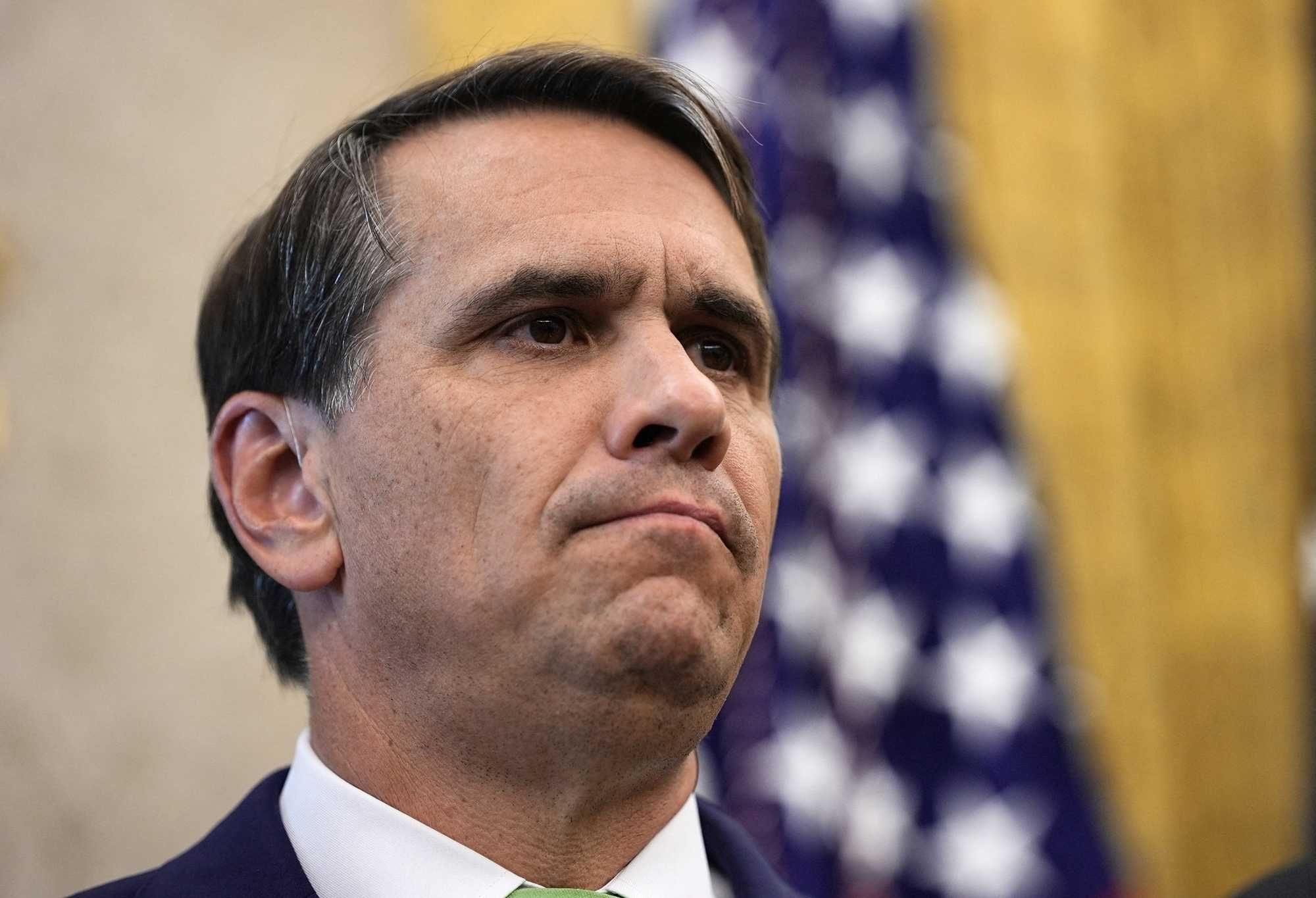
Acting U.S. Attorney General Todd Blanche in the Oval Office of the White House in Washington, D.C., U.S., June 26, 2026. REUTERS/Ken Cedeno
On Thursday, Financial Times reported that the U.S. Department of Justice (DOJ) was considering joining President Donald Trump's $10 billion defamation lawsuit against the BBC — which, he claims, edited one of his speeches in a misleading way. The following day, the BBC reported that Trump removed their commercial arm from the lawsuit, although the overall lawsuit would remain. And according to Law & Crime reporter Matt Naham, the BBC's legal strategy shows an aggressive effort to "turn the tables" on Trump and his allies.
"Weeks after Donald Trump's private lawyers bristled that the president's defamation lawsuit against the BBC threatened to put him on 'trial' for January 6 through discovery," Naham explains in Law & Crime, "the DOJ swooped in with a 'blanket challenge' of subpoenas. Now, the BBC is attempting to turn the tables, telling a judge the DOJ's decision to file the statement of interest in the first place 'raises grave ethical concerns, just like the ones' exposed in Trump's IRS case."
Naham adds, "The Friday filing from the BBC in U.S. District Judge Roy Altman's court said the DOJ's filing was 'improper' in multiple ways. The defendants argued that the DOJ's 'blanket' resistance of subpoenas for documents and communications of 'private individuals and organizations' — while repeating Trump's 'flawed arguments' — is the same kind of water-carrying that another judge in the district slammed at length one week ago. There, U.S. District Judge Kathleen Williams referred Trump attorney Alejandro Brito to the Florida Bar, also directing the court clerk to mail a copy of her order to the State Bar of New York — where Trump's former criminal defense attorney, Acting U.S. Attorney General Todd Blanche, faces an ethics investigation; Brito also filed the BBC lawsuit."
Williams, Naham notes, "found that Trump and the DOJ engaged in a 'non-adversarial, collusive' lawsuit to improperly force the IRS into a $1.776 billion 'settlement' that 'had no viable basis in law or fact.'"
The BBC, according to Naham, told Altman that the DOJ's statement of interest in Trump's defamation lawsuit against them should receive "no weight" because it raises serious ethical concerns comparable to the ones Williams recently addressed in Trump v. IRS."
The BBC filing quoted Williams in Trump v. IRS and wrote, "The government cannot brush those concerns away merely by asserting that Plaintiff filed this lawsuit 'in his personal capacity,' because to do so is to insist that this Court 'accept the credulous exercise of divorcing President Trump's current job title from an understanding of what happened here.' Indeed, Plaintiff identifies himself in the caption of the Complaint and throughout as 'President Trump.' In the face of this conflict of interest, where Plaintiff is arguing against Defendant's discovery both through his own personal lawyers and through government counsel, the only course that preserves fundamental fairness and due process would be to give the government's Statement no weight whatsoever in adjudicating this discovery dispute — a dispute in which, after all, the government need not have involved itself in the first place."