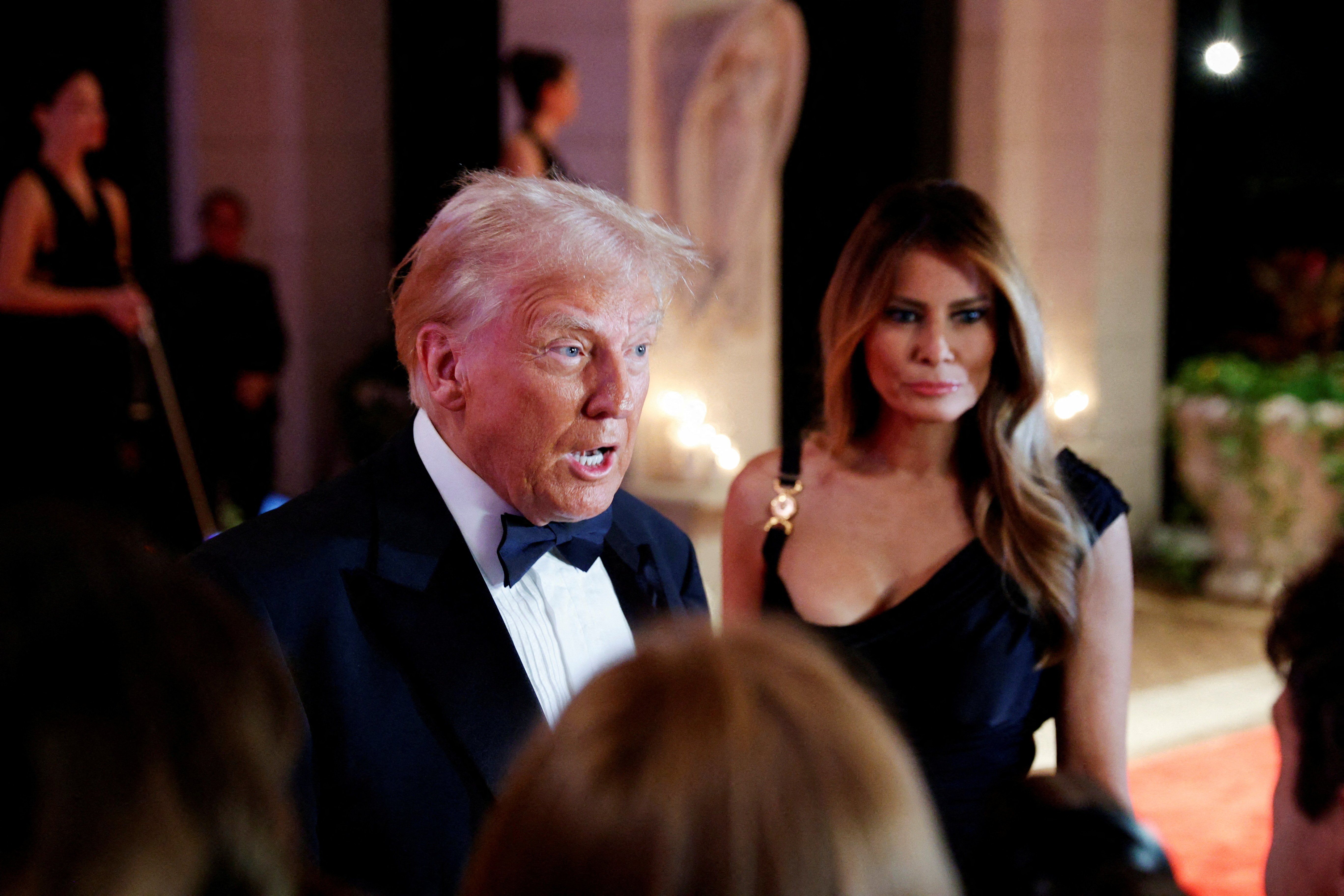
Donald Trump, accompanied by his wife Melania, attends a New Year's Eve event at Mar-a-Lago in Palm Beach, Florida, U.S., December 31, 2024. REUTERS/Marco Bello
When Donald Trump narrowly won the 2024 U.S. presidential election, many of the independents who voted for him cited the economy — especially inflation — as a key factor in their decision. Trump, on the campaign trail, promised to lower prices "on Day 1." But one year and a half into his second presidency, inflation is getting worse — not better — according to major economists like Paul Krugman, Robert Reich and the University of Michigan's Justin Wolfers.
Journalist Freddy Gray, writing for the UK-based i Paper, warns that many Americans believe the American Dream is on life support because the United States has become so unaffordable.
"Since COVID-19, inflation has eaten away at the 'American Dream,' and now, even those with good jobs and stable incomes find themselves taking on debt just to cover everyday costs such as putting food on their tables," Gray explains in his i Paper article. "Eating healthily has become financially onerous — the cost of vegetables, for instance, rose 12 per cent last year, tomatoes by 30 per cent in some states. In surveys, Americans report having to scale back on everyday indulgences, such as coffee or snacks, as well as cutting down on online subscriptions, just to afford the cost of more basic living."
Gray continues, "Housing is the greatest burden. Increased mortgage rates and stubbornly high property prices mean that buying a home is, for too many, beyond reach. The rental market is therefore often overcrowded. A typical urban-dwelling U.S. family will spend up to 60 per cent of their income on rent. In pricey San Francisco, the average cost of a two-bed apartment is $5200 (£3,880) a month. Owning and driving a car — that totemic symbol of the American life — is becoming financially difficult, too, especially in metropolitan areas. The costs of insuring, fueling, parking and financing a vehicle have all shot up in recent years. In Florida, partly as a result of extreme weather, car insurance premiums have increased by 75 per cent since 2020 — and in many states, full-coverage for motor vehicles is about twice as expensive as it is in the United Kingdom."
Joel Kotkin, an urban studies specialist at Chapman University in Southern California, argues that the U.S. has become a "neo-feudal" society — which, he warns, "threatens the future of democracy."
Another huge problem for the American Dream, according to Gray, is the high cost of education.
"Traditionally, American families achieved upward social mobility through higher education, or what Americans call college," Gray explains. "Those unable to afford the most elite institutions have long opted for public state universities. Today, however, even a cheaper college costs up to $30,000 (£22,385) per student per year in tuition and board. And it's median earners who find themselves too poor to afford the fees — yet too high-earning to qualify for generous financial aid schemes."