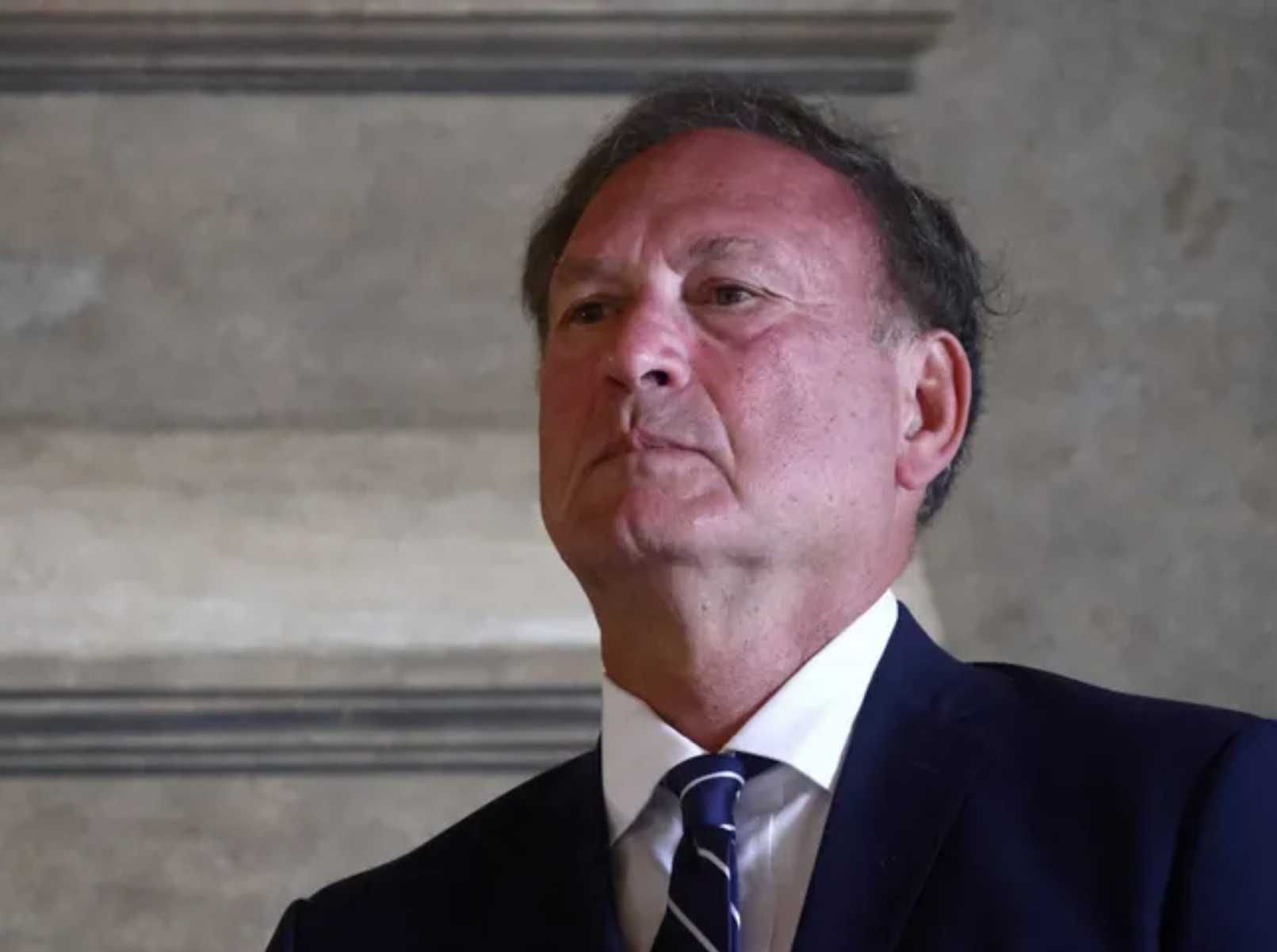
You might think that an arch-conservative who has used his lifetime seat on the Supreme Court to send U.S. law back to the 1920s would take a victory lap and maybe chill just a bit. But no. Despite his success in helping to dismantle abortion rights, attacking public-sector labor unions, elevating gun rights, promoting “religious liberty,” and destroying the Voting Rights Act, Justice Samuel Alito Jr. is still seething mad, motivated by ideological extremism and a stack of personal grievances, some dating to his childhood in Trenton, New Jersey.
Alito’s well-established pattern of outbursts was on full view during the court’s June 26 announcement of several late-term rulings. He set the tone for the session by reading a summary of his cruel 6-3 majority opinion that denied political asylum seekers the right to enter the country before reaching the U.S.-Mexico border (Mullin v. Al Otro Lado). Finishing quickly, he paused before moving on to summarize another of his opinions. Justice Soto Sotomayor apparently took the break in the action as a cue to read a synopsis of her dissent. Dissenters often refrain from reading their summaries, but there is nothing unusual about them opting to speak up, provided they give advance notice of their intentions.
Sotomayor blasted Alito’s handiwork. “The consequences of today’s decision are predictable,” she said. “More people will die. More people will attempt to cross the border illegally, and some will make it while others will not.” Her remarks apparently enraged Alito, making him look, in the words of NPR’s legal affairs correspondent Nine Totenberg, like “he had just bitten into a lemon.”
“There is much that I would have added to my bench statement had I known there would be a dissent read,” Alito said, uttering remarks that, in the staid confines of the nation’s most august judicial body, were veritable obscenities that prompted audible gasps from spectators and reporters in the gallery. A court spokesperson later clarified that Alito was in fact notified of Sotomayor’s plans, but to date, he has not publicly apologized. Like the president whose policies he almost always supports, Alito invariably overreacts and never recants.
Justice Samuel Alito Jr. is still seething mad.
Who can forget Alito sneering on live TV during Obama’s 2010 State of the Union address, mouthing the words “not true” as the president decried the court’s Citizens United opinion and the impact it would have on future elections, including greater foreign influence? Since then, Alito has only gotten more unhinged and offensive, becoming a regular featured speaker at Federalist Society events, railing against the legalization of gay marriage, labeling the Second Amendment and freedom of religion as “unfavored” constitutional rights, and condemning liberals as a threat to civil liberties.
In September 2021, Alito went ballistic after The Atlantic magazine staff writer Adam Serwer penned a column accusing the court’s right-wing majority of releasing a 5-4 shadow-docket ruling on Texas’ newly enacted vigilante abortion law in the middle of the night to minimize public outcry. In an hour-long live-streamed speech delivered at University of Notre Dame, he excoriated the press for portraying the court’s conservatives as “a dangerous cabal that resorts to sneaky and improper methods to get its ways,” and for feeding “unprecedented efforts to intimidate the court or damage it as an independent institution.”
In June 2023, Alito again went off the rails with an op-ed for The Wall Street Journal that lambasted a ProPublica report that in 2008 he took a luxury fishing trip to Alaska, flying for free aboard a private jet owned by Republican megadonor Paul Singer. The problem, according to ProPublica, wasn’t just that Alito had failed to recuse himself from reviewing lawsuits involving Singer’s hedge fund, but that he also failed to note anything about the excursion on the annual financial disclosure forms required under the Ethics in Government Act of 1978.
Claiming he had no duty to reveal the junket, he argued that his spot on the private jet “would have otherwise been an unoccupied seat” if he had not accepted the billionaire’s offer of a free ride, and that gifts of “hospitality” need not be reported. In a follow-up interview with the Journal, he added, “Congress did not create the Supreme Court” and “No provision in the Constitution gives them the authority to regulate the Supreme Court—period.”
Alito’s official court opinions have been equally acerbic and hyperbolic. They arguably reached a crescendo in his 2022 majority opinion overturning Roe v. Wade (Dobbs v. Jackson Women’s Health Organization). Not content with simply overruling the 50-year-old precedent on which U.S. women had come to rely as an essential part of their health care, he wrote: “Roe was egregiously wrong from the start. Its reasoning was exceptionally weak, and the decision has had damaging consequences.”
When used by a high court justice, the phrase “egregiously wrong” is an insult and a sign of contempt. And to add further insult, Alito reached deep into the bowels of Anglo-American common law to override Roe, citing the work of Henry de Bracton, a 13th-century English cleric and judge who condemned abortions as homicide, and a 17th-century English jurist who sentenced at least three women accused of using witchcraft to death.
So many of his hang-ups have become the law of the land.
What’s behind Alito’s fury and habit of issuing norm-breaking invective? As Georgia State University law professor Eric Segall told The Wall Street Journal in an article published this month, “Alito thinks of the other side as the enemy.” And true to Segall’s observation, Alito unwittingly admitted as much at the Supreme Court Historical Society’s annual dinner in 2024, when documentary filmmaker Lauren Windsor asked whether there was any way the country could overcome its terrible polarization, then surreptitiously recorded Alito’s answer that “there are differences on fundamental things that really can’t be compromised.”
Like most extremists, Alito has views that derive not just from his abstract political beliefs, but from his lived experiences growing up in a predominantly white Christian community as the son of deeply religious Catholic Italian immigrants, and later as an out-of-place right winger at Princeton University and Yale Law School.
In a revealing new biography, Revenge for the Sixties: Sam Alito and the Triumph of the Conservative Legal Movement, journalist Peter S. Canellos offers a compelling psychological portrait of Alito as a man dismayed by the demographic and secular changes that have transformed and, by his estimation, degraded the country of his boyhood. Alito has been on a mission to reverse those trends ex cathedra from his perch on the Supreme Court.
The problem is not that Alito has personal hang-ups — we all do — but that so many of his hang-ups have become the law of the land. On June 30, NPR’s Totenberg erroneously reported that Alito planned to retire so that President Donald Trump might nominate a younger right-wing zealot to the bench. The story turned out not to be true and was promptly retracted. Too bad for her — and even worse for the country.
- DC insider points out a slip that may confirm Alito's pending resignation ›
- Alito's influence on the Supreme Court may be reaching an all-time high ›
- Dems just handed a game-changing weapon — thanks to Alito and Thomas ›
- Trump might want to 'usher' Alito into retirement: CNN analysis ›
- Alito’s new book has conservatives sounding a lot like his liberal critics - Alternet.org ›