Political operatives are weaponizing a new tool that could reshape elections forever
28 April
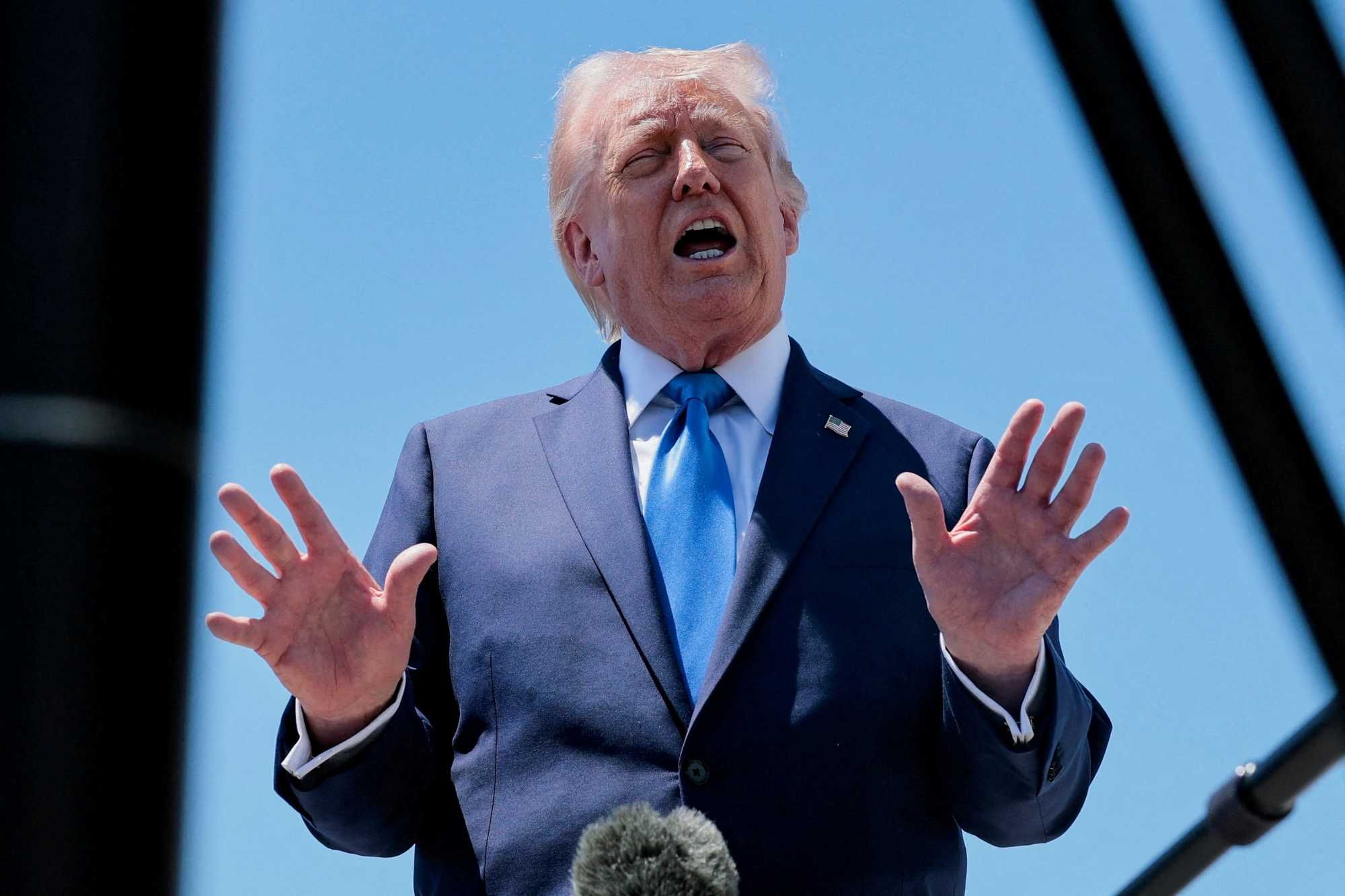
U.S. President Donald Trump at Palm Beach International Airport in West Palm Beach, Florida, U.S., April 25, 2026. REUTERS/Kylie Cooper
During recent appearances on MS NOW's "Morning Joe," Axios' Jim VandeHei spoke candidly about artificial intelligence (AI) and the effects it could have on the workplace. VandeHei's message: Instead of hating AI, workers will need to accept it as a reality and learn use it effectively in order to keep their jobs.
Others, meanwhile, are warning that AI could cause a lot of problems, from putting people out of work to creating new cybersecurity threats to data centers using huge amounts of electricity. And in the political world, insiders are thinking long and hard about the effects that AI will have on campaigns.
In an op-ed/essay published by the New York Times on April 28, journalist Thomas B. Edsall talks to political scientists and strategists about the "upheaval" AI could cause in the future.
"For better or worse," Edsall explains, "artificial intelligence is driving a major upheaval in American politics that will alter the substance and the character of campaigns. AI has emerged as a powerful political tool with the potential either to improve the quality of decision-making on Election Day or to do the opposite and subvert the process of deliberation. Perhaps surprisingly, a number of studies have shown that AI chatbots and large language models have stronger persuasive powers than humans."
According to Democratic strategist Joe Trippi, AI "is already invading everything from opposition research to digital ad production in ways that will accelerate and amplify the most powerful negative attacks and pinpoint the delivery of those attacks to voters most susceptible to the argument."
Trippi told Edsall, "As someone who pioneered the use of technology and the internet in politics, it's clear to me that AI will be used to manipulate and influence voters and citizens to stoke political division and further erode community and our democracy…. We have empowered a handful to become fabulously wealthy billionaires who build platforms and tools to keep us addicted to hours of doomscrolling through bots, deepfakes and algorithmic-driven choices."
Democratic strategist Paul Begala has mixed feelings about AI.
Begala told Edsall, "AI can be a force for good or for evil. It vastly increases the speed and scope of analysis, generates content and saves money. But at the end of the day, politics is still a human business. At some point in every campaign, the whole race comes down to a candidate and a campaign manager kicking a rock around in a parking lot saying, 'What do you think we ought to do?' That moment is magical. I doubt even the most powerful AI can replace that."
David Nickerson, a political science professor at Temple University in Philadelphia, predicts that AI "will definitely displace people in all parts of the electioneering industry."
Nickerson told Edsall, "Analysis that would take a day to do can now be done in an hour or even minutes. Surveys can be assembled faster. The gains in efficiency will allow a handful of people to do the work that would require dozens of people two years ago."
Nickerson added, however, "Fundamentally, politics involves people. The human touch is necessary for inspiring and building trust. Social networks are necessary to bring in local opinion leaders."
David Lazer, who teaches political science at Northeastern University in Boston, told Edsall, "Think of AI as the equivalent of doubling or tripling — or much, much more — the labor force of consultants, etc. That won't displace the industry, but it may displace some jobs. There will still be a major need for serious human expertise in surveys/etc. in using AI, because AI will act as a multiplier of sorts."