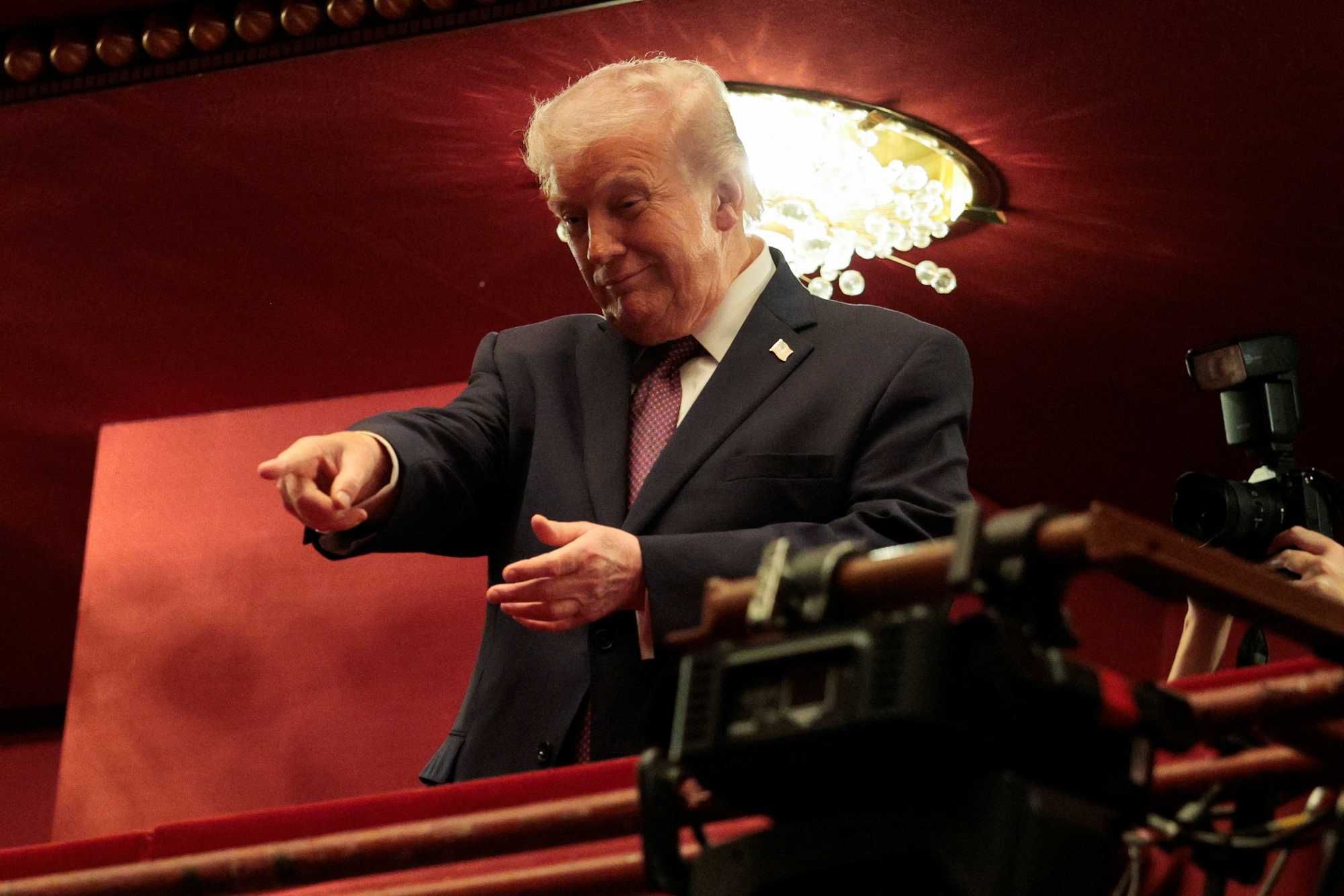
President Donald Trump recently posted an AI picture comparing himself to Jesus Christ, but a prominent theologian believes the president is more comparable to the Antichrist.
“My attention, however, has been turned back to the Antichrist, a figure who haunted my upbringing in the evangelical South but about whom, until the other day, I had given hardly a second of thought in decades,” Shaun Blanchard, a theologian at the University of Notre Dame Australia, wrote on Monday for the magazine America: The Jesuit Review. “For this renewed attention, I must credit not the oracles of Peter Thiel but the blunt observations of a former champion of the MAGA movement.”
He went on to quote the former Republican Rep. Marjorie Taylor Greene of Georgia, who described Trump’s post as “more than blasphemy. It’s an Antichrist spirit.”
From there Blanchard argued that Trump’s actions should be interpreted not as literally those of an Antichrist, but rather as reflecting a Satanic spirit that one associates with traditional religious notions of evil.
“My claim is not that Donald Trump is ‘the’ Antichrist or literally Satan,” Blanchard wrote. “My claim is that just as people like Robert Prevost — or Dorothy Day or Óscar Romero — can ‘image’ Christ, can show us glimpses of the face of Christ, so also those who descend into selfishness and egomania can ‘image’ Satan. Such people can channel and mediate the spirit of Antichrist in the world rather than the spirit of the Gospel. Most, however, do it a bit more subtly than Donald Trump’s social media posts.”
Indeed, as Trump piles on in his associating himself with Christ and attacking Pope Leo XIV, other scholars see him playing into America’s long history of anti-Catholic prejudice to benefit himself.
“Anti-Catholicism is baked into Anglo-American political culture,” Christendom College historian Christopher Shannon told AlterNet last week. “During the Revolution, patriot leaders from [future president] John Adams to Thomas Paine repeatedly denounced British oppression in language drawn directly from earlier denunciations of the Catholic Church. For example, in Common Sense, Paine likened monarchy to ‘popery.’”
Calvin University professor Kristin Kobes Du Mez has argued that Trump’s Jesus AI image "caused some real division within his religious base," noting that it is a rare moment when Trump has alienated some of his religious base. Similarly Matthew Sutton, a religious history scholar at Washington State University, has demonstrated that modern evangelical Antichrist speculation is linked to early 20th-century fundamentalism and end-times theology. Meanwhile the Rev. Franklin Graham defended Trump’s use of the image, arguing the president had no intention of depicting himself as Jesus.