Trump's scheme backfiring spectacularly as his approval rating just hit rock bottom
28 May
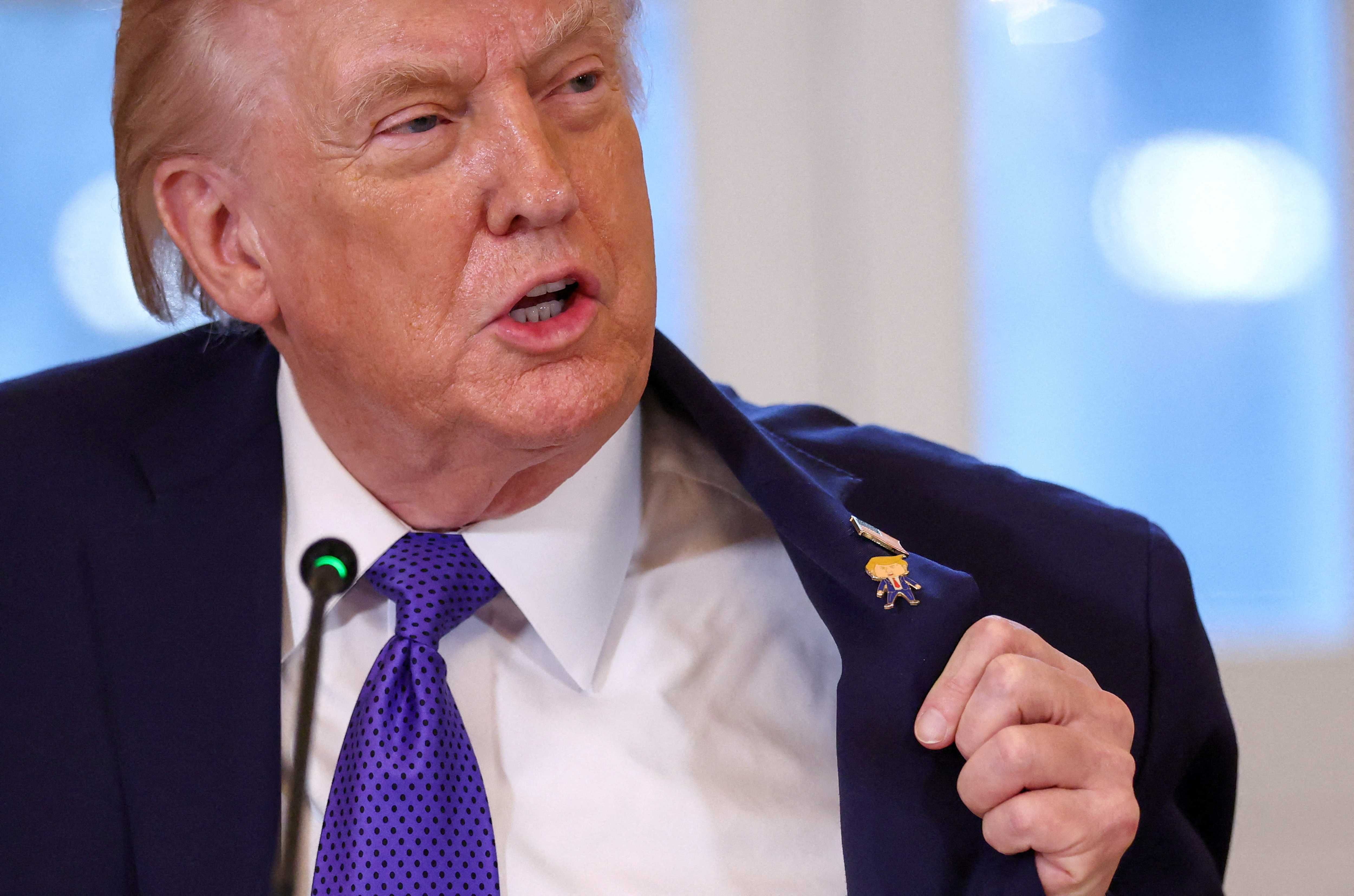
U.S. President Donald Trump in the White House, January 9, 2026. REUTERS/Kevin Lamarque
President Donald Trump recently created a $1.8 billion taxpayer slush fund for both his supporters and institutions directly linked to him. Many experts argue that the slush fund is illegal, but Forbes journalist Sara Dorn recently illustrated a point that is perhaps more immediately relevant for Trump — namely, that it is destroying him politically.
Writing on Thursday, Dorn wrote that as of an Emerson poll released that day “Trump logged a 39 [percent] approval rating in Emerson’s May poll, down from 40 [percent] in April, while his disapproval rating declined one point, to 55 [percent] (the survey of 1,000 likely voters was conducted May 24-25 and has a margin of error of 3).”
Dorn then reviewed Trump’s approval ratings going back several weeks, tracing a consistent decline that began because of his controversial tariffs and equally unpopular war against Iran and then seemingly solidified with his alleged self-dealing at taxpayer expense. Among her most notable findings, Dorn learned from a recent Economist/YouGov poll that “the majority of Republicans, 52 [percent], and a plurality of MAGA supporters, 45 [percent], oppose the controversial fund set up by the Justice Department to pay people who believe they’ve been victimized by the government.”
Dorn added, “Republican lawmakers have also revolted against Trump over the fund, which was established to settle Trump’s lawsuit against the IRS and is widely expected to offer taxpayer-funded payments to Jan. 6 rioters and other Trump allies.”
Despite some statistically insignificant fluctuations, Trump’s standings have continuously fallen, as have public perceptions of his handling of the economy (in the mid-30s), with a Fox News poll last week finding “the majority of voters surveyed said they disapproved of all five of the issues the poll asked about: border security, foreign policy, the economy, inflation and Trump’s summit with Chinese President Xi Jinping in Beijing last week.”
A Reuters/Ipsos poll taken around the same time even found that Republicans, who were once united behind Trump, are slowly peeling away from him.
“The share of Republicans who disapprove of his job performance has increased to 21 [percent] from 5 [percent] shortly after he took office in January 2025, while the share of Republicans who said Trump was doing a good job has decreased three points from earlier this month, to 79 [percent], and is down from 91 [percent] at the start of his term,” Dorn wrote.
For “key background,” Dorn explained that “Trump began his second term with a 52 [percent] approval rating and 43 [percent] disapproval rating, according to The New York Times’ polling average. He experienced a sharp drop in support with the announcement of his so-called ‘Liberation Day’ tariffs in April last year, and again since the start of the Iran war at the end of February. Voters’ economic concerns have remained high throughout Trump’s second term, and the Iran war has coincided with an increase in negative views of the economy as gas prices have skyrocketed since the start of the conflict.”
Dorn concluded, “Trump’s sagging approval rating comes as Democrats have a chance at outperforming Republicans in midterms, with Emerson’s May poll showing Democrats with a 9-point advantage on the generic congressional ballot, though 9 [percent] of voters were undecided.”
Trump’s slush fund will be controlled by five members appointed by Acting Attorney General Todd Blanche and has no guidelines about who will be paid and how much. They have not ruled out compensating the Jan. 6th insurrectionists and agencies connected to Trump. The fund was created when Trump sued the IRS for $10 billion as a result of his tax returns being released by a contractor during his first term. The lawsuit was controversial both because no plaintiff whose tax returns were released has ever received financial compensation and because Trump controls the Justice Department, which in theory would defend the IRS in the suit but in practice could not be expected to do so impartially when their boss is the one suing the agency.
When Judge Kathleen M. Williams, who was assigned to the case, decided to create a panel to determine the legality of Trump’s attempt to sue the IRS and whether a Justice Department beholden to the president could defend the IRS in good faith. She assigned a May 20th deadline for the matter to be brought back to her — and Trump therefore rushed to create the $1.776 billion slush fund before that deadline was reached.