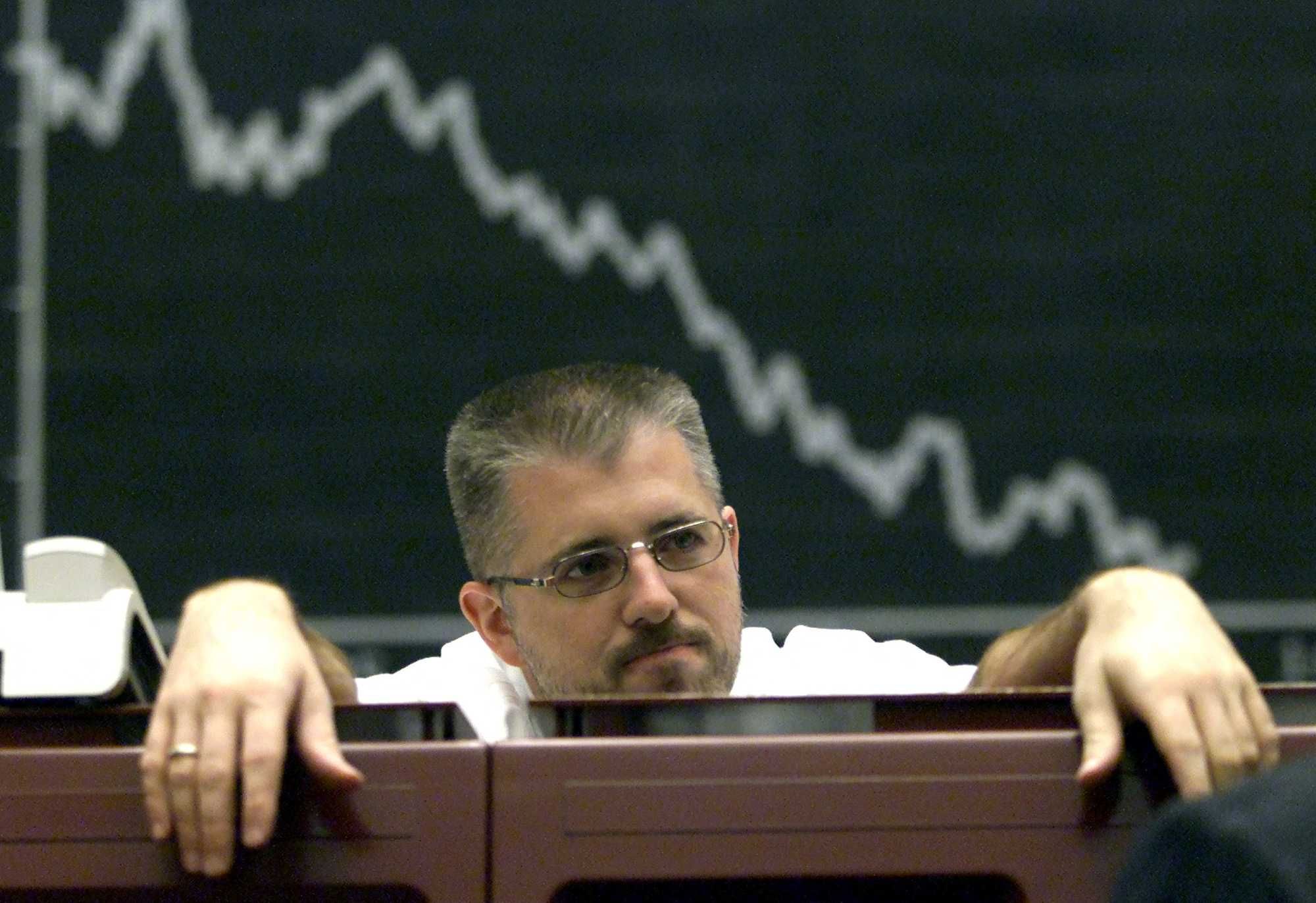
A broker is seen under the board of the DAX (German stock market index) at Frankfurt's stock exchange September 10, 2001.
This daily letter to you doesn’t offer financial advice. And most of you have been so worried by the nation’s lurch toward dictatorship under loathsome Trump that it seems almost unfair to burden you with an alarm about the economy. But we’re facing a five-alarm fire that you need to know about.
Much of the United States economy is now based on A.I. — or, more specifically, expectations that A.I. will pay off very big in the near future. A.I.-related stocks have accounted for roughly half of the rise in the S&P 500 this year. And U.S. economic growth is dependent to a remarkable degree on A.I. infrastructure spending.
But it’s becoming a house of cards.
Yes, America now dominates A.I. with the most powerful systems and more data centers than any other nation. But that lead hasn’t come free of charge, and it’s eroding quickly.
The lead is based on colossal spending on data centers, especially by Oracle, Alphabet, Microsoft, Amazon and Meta. A stumble by any one of them would spill over to the rest of the economy.
It’s estimated that these five companies combined will account for more than $800 billion in A.I. investments this year. They plan to spend a additional $1.2 trillion in 2027 — more than Trump’s entire military budget request for 2027.
Where’s all this A.I. money coming from? Some from investors, but much of it is being borrowed.
One worry is their borrowing is outpacing their profits. Not surprisingly, the bond market has begun to charge premiums for what it considers a heightened risk that they won’t be able repay.
Oracle’s debt now stands just a bit above junk bond status. Amazon’s bond prices have also been hard hit. So have those issued by SpaceX, which is also building A.I. data centers and whose bonds have been trading at junkish rates.
Here’s another worry. Chinese A.I. companies are now offering A.I. that’s almost as good as that emerging from Anthropic and OpenAI — but Chinese companies are offering it free of charge to companies anywhere in the world, including in the United States. This is likely to mean lower earnings for leading American A.I. corporations and less demand for data centers.
Last month, Chinese start-up, Z.ai, released a model that’s been rapidly adopted by start-ups and independent developers across Silicon Valley.
What’s the consequence? So far this year, the stock prices of four of the five big data-center companies have trailed the overall S&P 500. Oracle’s shares have fallen more than 35 percent. Shares of SpaceX have fallen below their initial public offering price.
On Thursday, a Chinese start-up called Moonshot AI, released a new A.I. model called Kimi 3, that’s nearly as powerful as the leading American model, Anthropic’s Claude Fable 5. Moonshot said it would soon provide Kimi 3 as open source, essentially free. The news caused a sell-off of U.S. technology stocks on Friday.
The latest systems from companies like Anthropic and OpenAI still outperform Kimi and other Chinese models, but the top Chinese models are far cheaper — which is why Anthropic and OpenAI are now urging the Trump regime to block imports of Chinese A.I. Yet such blockage would competitively harm much of the rest of the tech sector and other big American companies that are using Chinese A.I.
The third worry is how much economic activity in the U.S. now depends on A.I. If investor confidence in A.I. crumbles, much of the economic activity built on it could come crashing down. The sell-off would make it more expensive for companies to raise and borrow the capital they need to fund further A.I. investments, causing companies to delay or cancel their plans for data centers and related infrastructure.
The drop would also push wealthy consumers to pare their spending. Much consumer demand in the U.S. now turns on spending by the richest 10 percent of Americans who own over 90 percent of the value of all shares of stock traded on U.S. stock exchanges. They’re spending like mad now, largely because the ebullient stock market has made them feel far richer. If the market drops, they’ll pull back on their spending, which could lead to wider job losses and, ultimately, a recession.
Bank of America’s monthly global fund-manager survey for July reports that fund managers see the key risk to financial markets to be a bursting of the A.I. bubble. It’s also now the key risk to the economy.
I don’t want to rain on the A.I. parade. Maybe — just maybe — the extraordinary price-earnings ratios of A.I. companies will be justified by torrent of A.I. buying by consumers and businesses in the next few years.
Even if it’s a bubble, it’s impossible to predict when it will burst. Maybe not for several years. And maybe not with a bang but with a whimper.
But the sobering reality is this: the U.S. economy has become so concentrated in a handful of giant A.I. corporations, so highly leveraged with A.I.-related debt, and so dependent on predictions about huge earnings flowing from A.I. in the foreseeable future, that the risks of a recession or even a crash are growing.
Yes, we have fiscal and monetary policy tools to counteract a sudden downturn. But will those tools will be powerful enough to respond if a significant portion of business and consumer demand suddenly shrinks, when investors and creditors are left holding nearly-worthless pieces of paper, when the United States is already deep in debt, when the competence of government policy makers is highly questionable, and when trust in government has never been as low as it is today?
Robert Reich is a professor of public policy at Berkeley and former secretary of labor. His writings can be found at https://robertreich.substack.com/